
Closed beta or design partners? A founder’s low-risk way to prove the riskiest assumption
A practical comparison of closed beta and design partner approaches for founders who want to learn fast without building too much. It explains what each one is for, where each can mislead you, and how to choose the lightest test for your riskiest assumption.

On this page
Why it mattersThe differenceWhich to choosePractical usePitfallsSafeguardsWhen to get helpIn short
- Use a closed beta when the product is already fairly defined and you need controlled feedback from a focused user group.
- Use design partners when you still need to shape the problem, the workflow or even the product concept.
- Do not confuse eager users with representative users; both a16z and Intercom warn that early feedback can mislead if the group is not well chosen.
- Keep the test narrow: one user type, one job to be done, one or two things to observe.
- If the feedback is weak or contradictory, that is useful evidence too. It may mean the problem is not ready, not that you should add more features.
If your product idea is still uncertain, the worst move is often to build too much before you have evidence. A small, controlled test can tell you far more than a broad launch, but only if the test matches the question you are trying to answer. Closed betas and design partners are both useful, but they serve different jobs. One is better for structured feedback on something close to a product. The other is better for shaping the product itself with a few committed users. The key is to choose the lightest approach that can still answer the hardest question.
Why the choice matters before you build more
Founders often want validation, but they do not always need the same kind of validation. If you already know the shape of the problem, a closed beta can give you sharper product feedback without exposing the work to a wider audience. If you are still working out what the product should be, a design partner relationship can help you learn which workflow, features and packaging matter most.
The mistake is to treat both approaches as interchangeable. A beta is not just a smaller launch. A design partner programme is not just a list of friendly users. Each one creates a different kind of learning loop, and each one can fail in a different way.
Closed beta and design partners, compared
Closed beta
A closed beta is a controlled release to a focused group of users, usually when you have something close to a product and want to watch how it behaves in real use. The emphasis is on feedback, bugs, friction and whether the experience holds up with the right kind of users. Intercom suggests beta users should share the same problem and be a tight group, because broad and mixed feedback can blur the learning.
Design partners
Design partners are the first few users you involve to help shape what you build, how it should work and sometimes how it should be packaged. Andreessen Horowitz describes them as early users who can help shape functionality, user experience, pricing and packaging, and who can speed a company towards product-market fit.
Best when
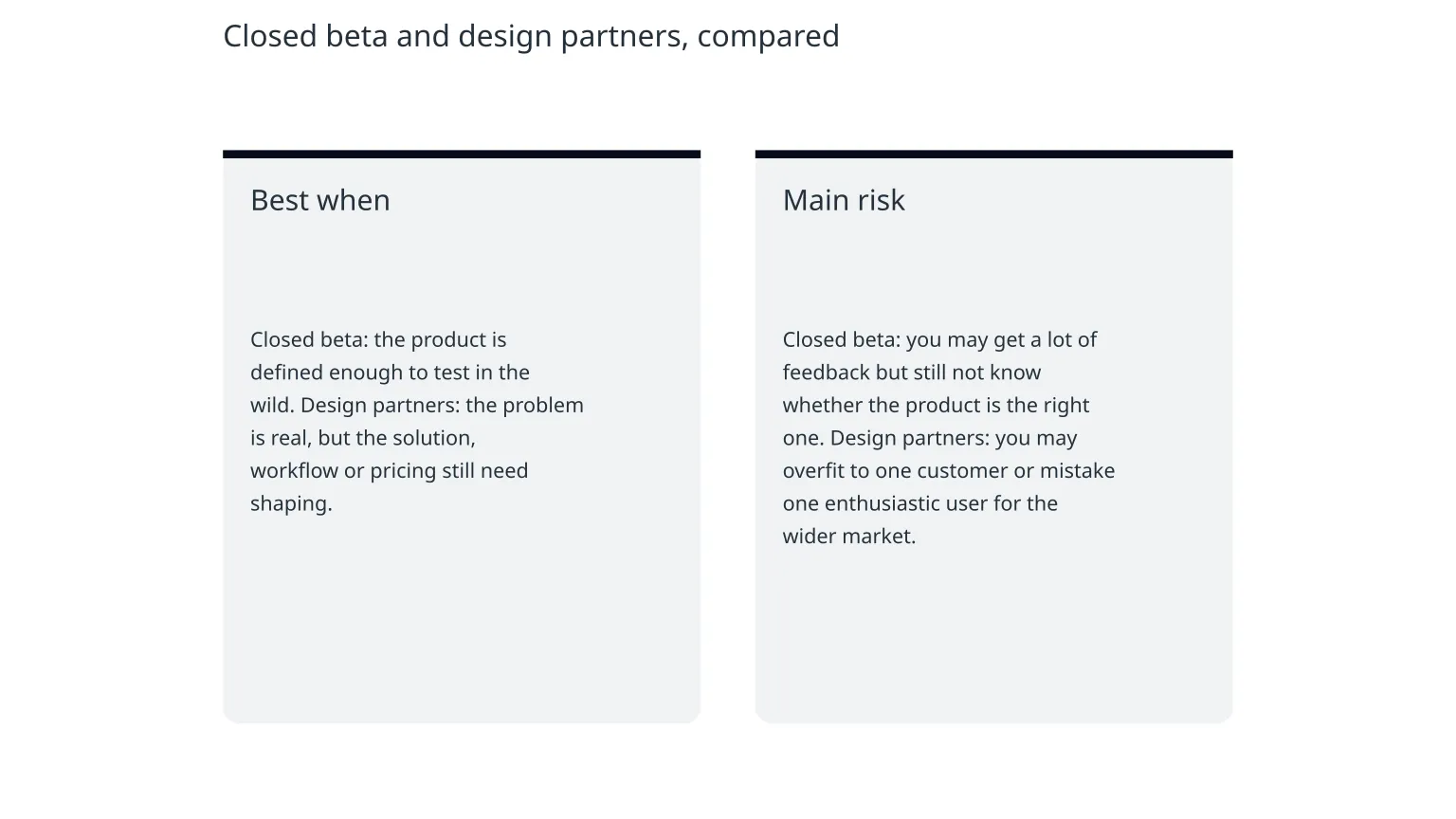
Closed beta: the product is defined enough to test in the wild. Design partners: the problem is real, but the solution, workflow or pricing still need shaping.
Main risk
Closed beta: you may get a lot of feedback but still not know whether the product is the right one. Design partners: you may overfit to one customer or mistake one enthusiastic user for the wider market.
In practice, the two approaches can overlap. A design partner may later become a beta user, and a beta user may become a design partner. The important point is not the label. It is the purpose of the relationship and the type of evidence you want to collect.
How to choose the lightest test that still answers the real question
- 1
Start with the riskiest assumption
Ask what has to be true for the business to make sense. Is it that people have the problem, that they will try the workflow, that they will pay, or that they will keep using it? Choose the test that can most directly challenge that assumption.
- 2
Decide whether you need shaping or validation
If the main unknown is how the product should work, design partners are usually the better fit. If the product shape is mostly settled and you need to see how it behaves with real users, a closed beta is often enough.
- 3
Check whether the users are representative
a16z warns that early users should be evaluated for urgency, representativeness and capacity, and that smaller or earlier-stage companies are not always the best design partners because their requirements can shift quickly. If the people in your test are not like the people you want to serve, the feedback may be flattering but not useful.
- 4
Avoid building around the loudest voice
A single design partner can help you move fast, but it can also pull the product in one direction. Use one customer’s feedback as input, not as a blueprint. The same caution applies to beta users who are especially engaged or unusually forgiving.
- 5
Choose the smallest credible prototype
a16z notes that the early product can be a mock, a prototype or even something manual behind the scenes, as long as you can collect good feedback quickly. That is a reminder that the point is learning, not polish.
What each approach is good for in real MVP work
Closed beta
Useful for checking whether the experience works, whether the workflow is usable, and whether the product creates the intended result without unnecessary complexity.Design partners
Useful for discovering which problem matters most, how people describe it in their own language, which features are worth building, and what pricing or packaging might feel reasonable.Closed beta
Helpful when you want to observe behaviour, gather bug reports, compare expectations with actual use, and test whether the solution survives contact with real users.Design partners
Helpful when you still need qualitative insight, repeated conversations and a small number of committed users who can react quickly as the product changes.Where founders go wrong
- Treating a design partner as proof of market demand. Interest is not the same thing as repeat use or willingness to pay.
- Using a closed beta to ask too many open-ended questions. If the test has no focus, it becomes noise rather than evidence.
- Choosing users who are too similar to you, too polite to be useful, or too early-stage to evaluate alternatives properly.
- Overbuilding the product before the test begins. A beta should reduce uncertainty, not hide it behind extra features.
- Ignoring negative or confusing feedback because it feels uncomfortable. In many cases, that uncertainty is the most valuable thing the test reveals.
How to keep the learning honest
0 of 6 complete
If the product involves AI, automation or sensitive workflows, keep human approval in the loop for consequential actions and be explicit about where the system should stop and ask. That is not a separate validation exercise; it is part of making the test safe enough to trust.
When outside help is useful
Specialist support is most useful when you know the assumption you need to test but do not yet know how to scope the smallest credible experiment. That can include defining the MVP, mapping the user journey, building a lightweight prototype, setting up a closed beta, or designing a workflow that collects feedback without overengineering the product.
For founders who want to move carefully, this can be a practical place to use a scoped discovery or MVP engagement. The right aim is not to make the product bigger. It is to make the next decision clearer.

About the author
Nixim Team, Product Engineering
Practical guidance from Nixim on building software, working with AI and running dependable cloud systems.