
Delete, automate or delegate? A founder’s checklist before you build an AI workflow
A practical guide for founders deciding whether a process should be removed, handed to a person or supported by AI before they spend budget on a build. It focuses on the business decision first: what to test, what to postpone and what to validate.

On this page
WhyTestSafeguardsPilotChecklistNextIn short
- Start with the task, not the model.
- Delete work that no longer needs to happen.
- Delegate tasks that need judgment, context or human reassurance.
- Automate only when the process is stable enough to repeat.
- Use a small pilot to test value and risk before scaling.
Many founders start with the tool they want to use. The better question is the one that comes first: should this process exist at all, should a person do it, or does it really need automation?
That shift matters because AI is not the answer to every repetitive task. Some work should be deleted. Some should be delegated. Some should be simplified before anyone writes a prompt, connects a model or pays for a custom build. UK guidance for small businesses suggests exactly this kind of sequence: start from the pain point, then decide whether to delete, automate or delegate.
This article gives you a simple way to make that decision before you commit time and budget to an AI workflow.
Why the decision comes before the build
If a process is messy, unclear or rarely repeated, AI can make the wrong thing faster. That is why the first step is not choosing a model. It is deciding whether the task is worth keeping, who should own it, and what outcome you actually need.
The Small Business Commissioner’s advice is useful here: start from the pain point and ask whether the work can be deleted, automated or delegated. That is a better filter than “can AI do this?” because it keeps the business goal in view.
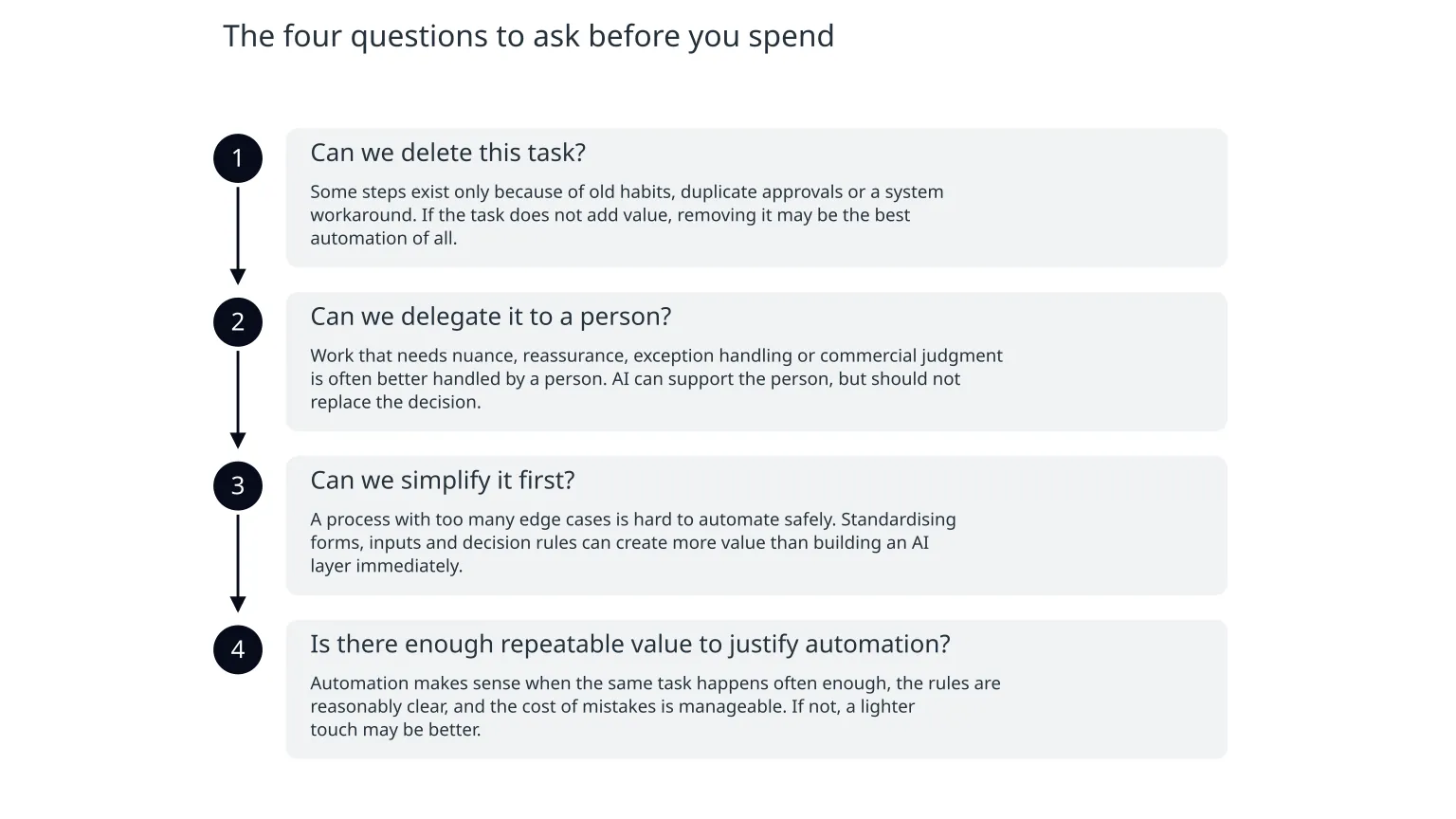
The four questions to ask before you spend
- 1
Can we delete this task?
Some steps exist only because of old habits, duplicate approvals or a system workaround. If the task does not add value, removing it may be the best automation of all.
- 2
Can we delegate it to a person?
Work that needs nuance, reassurance, exception handling or commercial judgment is often better handled by a person. AI can support the person, but should not replace the decision.
- 3
Can we simplify it first?
A process with too many edge cases is hard to automate safely. Standardising forms, inputs and decision rules can create more value than building an AI layer immediately.
- 4
Is there enough repeatable value to justify automation?
Automation makes sense when the same task happens often enough, the rules are reasonably clear, and the cost of mistakes is manageable. If not, a lighter touch may be better.
Where AI helps, and where it should stop
Good AI workflows are usually narrow. They support one bounded task, not an entire business function at once. They also need a clear point where the system stops and asks a person to review, approve or handle an exception.
That matters because governance guidance from NIST and the UK Government both emphasise clear roles, oversight and human responsibility. The OECD also highlights the risk of automation bias, where people trust an AI output too quickly and miss errors that a human would have caught.
Better for automation
Repeated, structured work with clear inputs, predictable outputs and a manageable error rate.
Better for a person
High-stakes decisions, unusual edge cases, customer-sensitive communication and work that depends on judgment or context.
A practical safeguard is to define the handoff before you build. For example, a draft response may be generated by AI, but a person approves the final version when the issue is sensitive or the confidence level is low. That is consistent with current guidance on human oversight and lifecycle risk management.
What to validate before a full build
A pilot should prove a business decision, not just a technical possibility. Before building properly, validate three things: the process, the risk and the value.
- Process: can you describe the task clearly enough that another person could follow it?
- Risk: what happens if the AI is wrong, slow or uncertain?
- Value: does this save time, reduce errors, improve service or remove a bottleneck that matters?
Illustrative example: if a founder wants to automate first-line email triage, the pilot should not try to answer every message. It should test whether the system can route simple requests correctly, send uncertain cases to a person, and show that the team still keeps control. That is a safer test than aiming for full autonomy on day one.
Another illustrative example: if you want AI to read incoming documents, first test whether the documents are consistent enough to classify. If the source material is highly variable, the right next step may be standardising the intake form rather than automating extraction immediately.
A simple founder checklist
0 of 8 complete
A sensible next step for founders
If your checklist shows that a process is repetitive, stable and bounded, automation may be worth exploring. If it is unclear, political, high-risk or poorly defined, the better move may be to delete the step, delegate it, or redesign the process first.
That is where specialist help can be useful: not to push AI into every workflow, but to scope the process properly, design the human handoff, and keep the first version small enough to learn from. Nixim’s founder-facing AI workflow scoping and related product work are relevant when you already know the business outcome you want and need help testing the safest, simplest path to it.

About the author
Nixim Team, Product Engineering
Practical guidance from Nixim on building software, working with AI and running dependable cloud systems.