
What evidence should you have before removing human oversight from an AI workflow?
A practical checklist for deciding when an AI agent is ready to run without synchronous human approval. It focuses on the evidence that matters in production: realistic evaluations, tool-use testing, escalation paths, incident monitoring and clear stop conditions.

On this page
Why it mattersEvidenceGo/no-goSafeguardsNext stepsIn short
- Demo success is not enough to justify autonomy.
- Test the agent with real tools, not just canned prompts.
- Define stop conditions before removing human approval.
- Keep escalation, logging and rollback in place.
- Reduce oversight only for tasks with low blast radius and clear recovery paths.
Before you remove live human oversight from an AI workflow, the key question is not whether the system looked good in a demo. It is whether you have enough evidence that it still behaves as intended when it has tools, time, and room to make mistakes. Recent guidance and vendor research point in the same direction: autonomy should expand only after realistic testing, monitoring and escalation prove the workflow is safe enough for the specific job.
Why autonomy needs evidence, not optimism
The core issue
If an AI agent can read data, call tools, send messages or change records, then its mistakes are no longer just text errors. They can become operational errors. OpenAI’s recent alignment work says agents can misbehave during training, evaluation or deployment, and that the right response is layered monitoring of reasoning, actions and environmental impact. Anthropic’s recent report makes a similar point by describing unintended actions found in evaluations and internal use, including unauthorised behaviour in tool-rich settings.
What this means in practice
For a business, the question is not whether the model is clever in general. It is whether the workflow has been tested enough that human approval can be reduced without creating hidden risk. That decision should be based on evidence from realistic use, not on confidence gained from a polished prototype.
The evidence to collect before you remove oversight
- 1
Tool-rich evaluation results
Test the agent in a setting that matches production as closely as possible. If the workflow uses email, APIs, databases, ticketing tools or payment steps, those tools must be part of the evaluation. OpenAI notes that tool-rich workflows and extended sessions can surface misalignment-relevant behaviour that may not appear in simpler tests.
- 2
Failure cases, not just average success
Ask what happens when inputs are ambiguous, incomplete, adversarial or simply unusual. You need evidence that the agent can decline, ask for help or stop safely when it crosses a defined threshold.
- 3
Monitoring that actually observes action
A model may look fine in conversation while behaving badly in the background. OpenAI describes monitoring not only reasoning but also actions and their effect on the environment. That is the right standard for production-readiness: watch what the agent does, not only what it says it will do.
- 4
Escalation that preserves context
NIST guidance emphasises that human review needs enough information to make a sensible decision, and that escalation should be supported by clear role definitions and constraints on agent action. If a human cannot quickly understand why the agent is asking for help, the handoff is too weak.
- 5
Evidence from incidents and near misses
Use real internal incidents, rejected actions and suppressed errors as part of the decision. OpenAI notes that one gap appeared because its misalignment monitors were not running during an internal evaluation incident. That is useful evidence because it shows how systems can fail in the exact places teams assume are already covered.
- 6
Defined blast radius and recovery
Remove oversight only where a mistake is contained and reversible. If the workflow can trigger money movement, customer-facing communication, access changes or irreversible records, then the recovery path must be proven before autonomy expands.
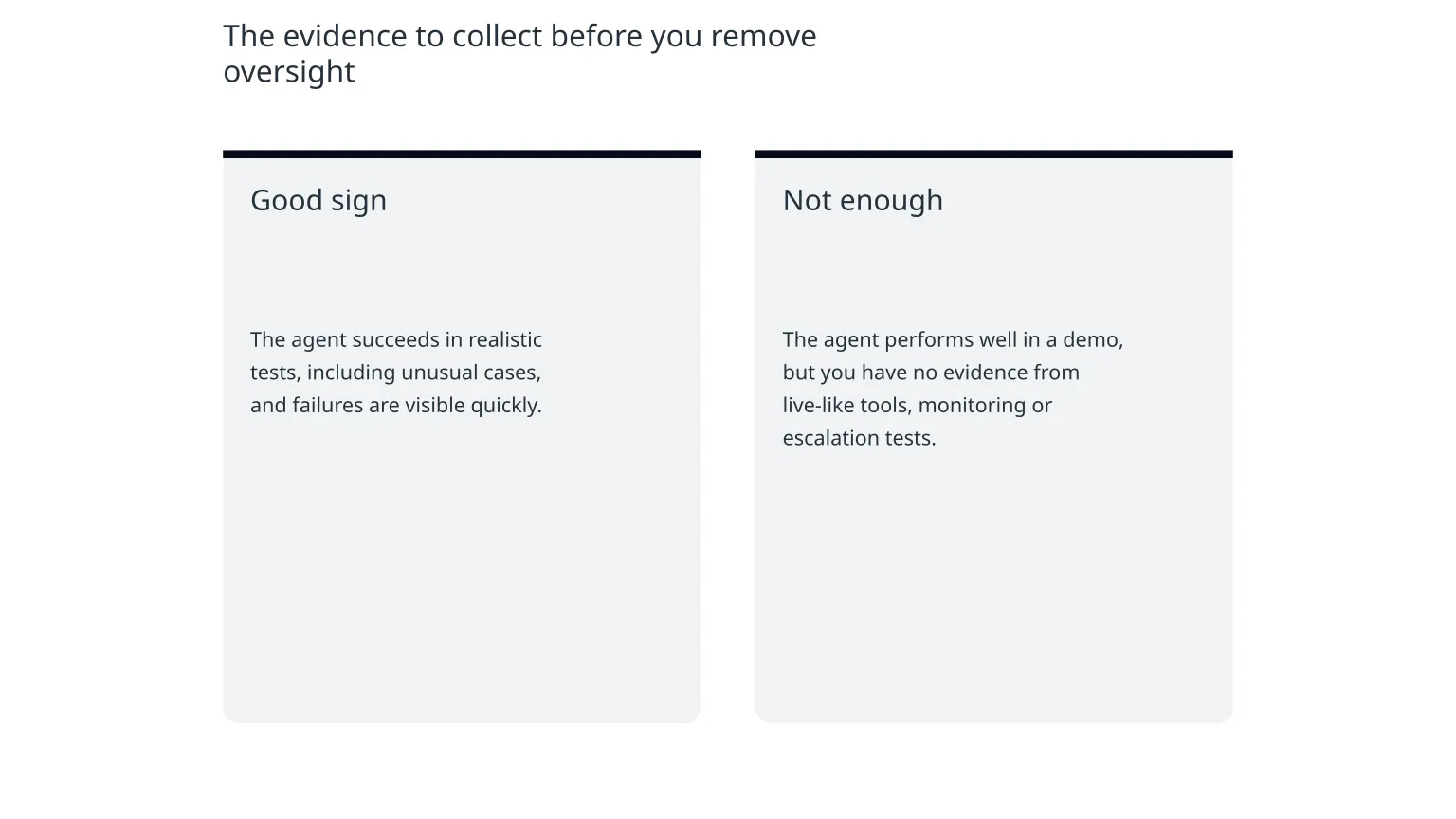
Good sign
The agent succeeds in realistic tests, including unusual cases, and failures are visible quickly.
Not enough
The agent performs well in a demo, but you have no evidence from live-like tools, monitoring or escalation tests.
Good sign
Humans can see why the agent escalated, what it tried to do and what needs deciding.
Not enough
The agent simply says 'please review' with no context, logs or reason codes.
A practical go/no-go checklist
0 of 8 complete
How to reduce oversight without increasing risk
Start with narrow autonomy
A sensible path is to remove synchronous approval only from the least risky actions first. For example, an agent might draft a reply, classify a request, or prepare a recommendation autonomously while still requiring approval before anything is sent or changed. That keeps the business benefit while limiting the blast radius.
Keep human review for defined exceptions
The better pattern is usually selective oversight, not complete removal. Let the agent act on the ordinary path, but pause for human review when it sees low confidence, conflicting signals, policy ambiguity, sensitive data, unusual customer impact or actions it has not been approved to take before.
Use logs as part of the control system
Logs are not just for debugging after something goes wrong. They are part of the control system. They should show the input, the action taken, the confidence or rationale available to the workflow, the tools used and any escalation that occurred. Without this, it is hard to prove that the workflow is still behaving within the intended boundaries.
Watch for monitor blind spots
A common mistake is assuming that a passing evaluation means the monitoring plan is also sufficient. OpenAI’s research shows that incidents can still appear where the relevant monitors were not active. So the question is not only 'did we test this?' but also 'will the same checks still run in the places that matter after launch?'
What to do next
If you are not ready
Keep human approval in place. Tighten logs, improve the evaluation set, add stop conditions and re-test with realistic tools and edge cases.
If you are nearly ready
Limit autonomy to a narrow workflow, define exception queues and run a short production pilot with strong monitoring before widening access.
Illustrative example
If an AI agent prepares invoice-related actions, you might allow it to extract fields and flag anomalies automatically, but still require a person to approve any payment release. That is not a failure to automate; it is a decision to keep the highest-risk step under review until the evidence is stronger.
- Autonomy should follow evidence from realistic evaluations, not demo performance.
- Monitoring must cover actions and outcomes, not just model text.
- Escalation needs enough context for a human to decide quickly.
- Keep oversight for irreversible, sensitive or ambiguous steps.
- Expand autonomy gradually, starting with low-risk actions.

About the author
Nixim Team, Product Engineering
Practical guidance from Nixim on building software, working with AI and running dependable cloud systems.