
Should you fix account and self-service flows before spending more on acquisition?
If customers are getting stuck after purchase, more traffic can simply create more support work. This article explains how account, returns and self-service friction affects retention, how to judge whether it is worth fixing first, and what a practical improvement plan looks like.

On this page
Why it mattersWhere to lookHow to decideWhat to buildSafeguardsNext stepsIn short
- Fixing postpurchase friction can improve retention without increasing ad spend.
- Account, returns and self-service journeys are common places where avoidable effort builds up.
- Start with the highest-friction step, not a full redesign.
- Use support tickets and task completion to choose the first fix.
- Add automation carefully, with human handoff for exceptions.
If customers are stuck in sign-in, returns or support flows, more traffic may just amplify the same friction. The question is not whether acquisition matters. It is whether your current customer journey is leaking value after the sale, so every new customer costs more support time and delivers less repeat business than it should. Evidence from usability research and customer-service studies suggests postpurchase friction is often a growth issue as much as an operations issue.
Why postpurchase friction belongs in a growth conversation
A business can have a healthy top of funnel and still underperform if customers struggle after buying. Sign-in problems, unclear order tracking, hard-to-use returns flows and weak account dashboards create repeat contacts, delay resolution and reduce trust. Baymard’s 2026 research update says it observed more than 1,400 usability issues across 4,000+ hours of research, covering account, sign-in, order tracking and returns flows. That is a strong signal that these areas still matter operationally.
The growth angle is simple: if the same issues keep generating support demand, then extra acquisition often just adds more cases to the same broken journey. Gartner’s research frames postpurchase satisfaction as a lever for loyalty and retention, while its churn guidance says teams should monitor the customer journey before churn becomes obvious.
The flows most likely to deserve attention first
- Sign-in and password reset: where access issues create immediate frustration.
- Account dashboard: where customers should be able to see orders, addresses, payment details and status without asking for help.
- Order tracking: where uncertainty leads to tickets even when the underlying fulfilment is fine.
- Returns and exchanges: where unclear steps can stop a customer from completing the process.
- Payment and billing updates: where card changes or failed payments can trigger churn if the path is confusing.
Baymard’s accounts and self-service collection specifically includes these areas, and its returns guidance says the returns experience is critical for retention, yet many sites still have substantial UX issues. That makes returns a good candidate when you need a clear first fix rather than a vague “improve CX” programme.
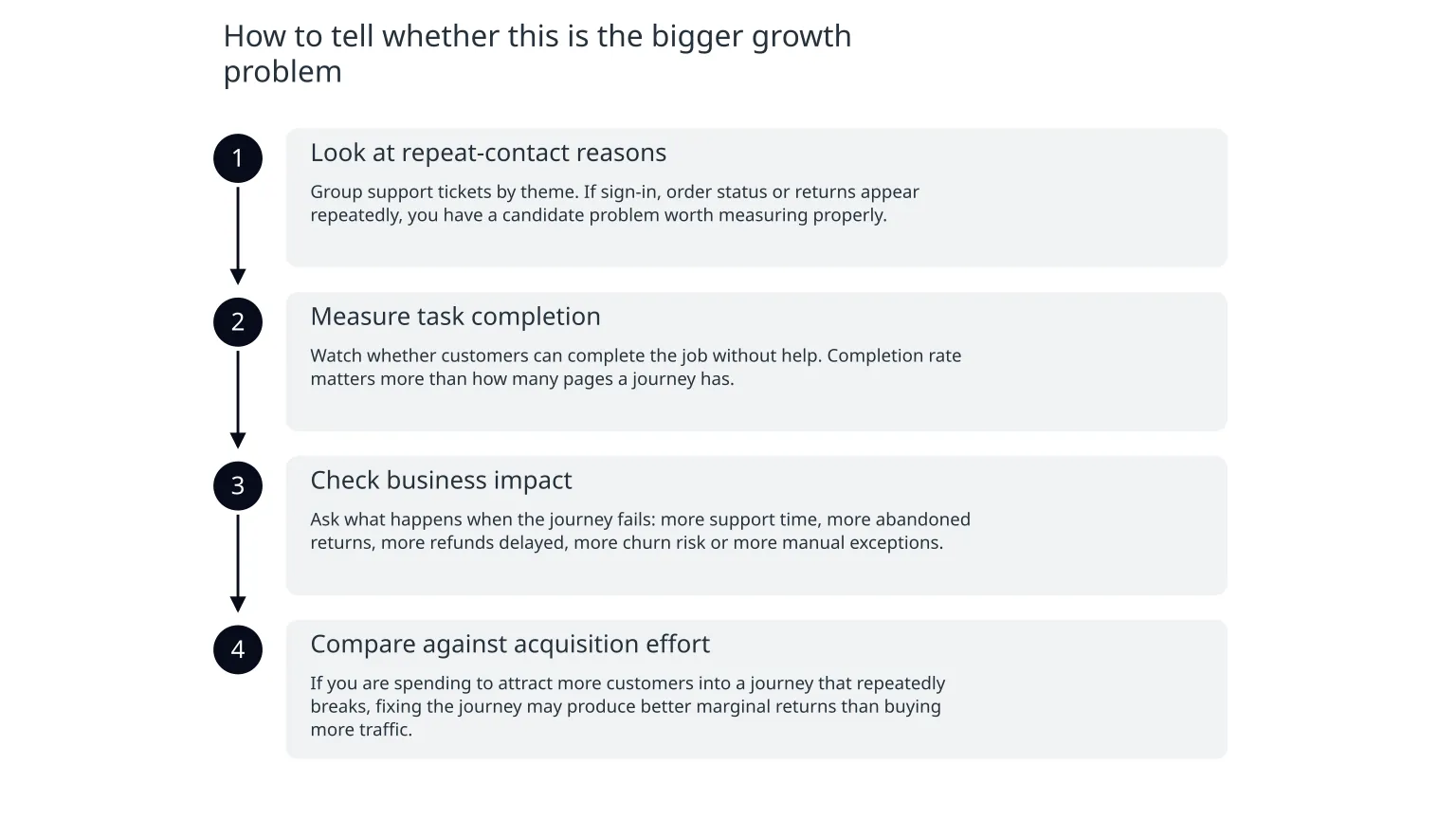
How to tell whether this is the bigger growth problem
- 1
Look at repeat-contact reasons
Group support tickets by theme. If sign-in, order status or returns appear repeatedly, you have a candidate problem worth measuring properly.
- 2
Measure task completion
Watch whether customers can complete the job without help. Completion rate matters more than how many pages a journey has.
- 3
Check business impact
Ask what happens when the journey fails: more support time, more abandoned returns, more refunds delayed, more churn risk or more manual exceptions.
- 4
Compare against acquisition effort
If you are spending to attract more customers into a journey that repeatedly breaks, fixing the journey may produce better marginal returns than buying more traffic.
What a sensible fix usually looks like
Good first step
Improve the highest-friction journey with clearer status, simpler language, better error handling and a clean human escalation path.
What to avoid
Rebuilding every customer-facing flow at once, or adding automation that hides the route to a person when the system cannot resolve the issue.
Verint’s 2026 survey reporting says customers want fast resolution, and that automation only helps when it actually resolves the issue end to end and can hand off to a human when needed. Deloitte’s contact-centre research also warns that self-service failures can compound trust loss and cost. Put together, the message is not “automate everything”. It is “remove preventable friction, then automate the stable parts.”
For many businesses, that means a small product-and-operations project rather than a big rebuild: better labels, clearer status updates, fewer steps, exception handling, and logging that shows where users get stuck. If the system behind the flow is fragmented, a custom web or mobile app layer can help bring the journey together without changing everything underneath.
How to improve safely without creating new problems
0 of 6 complete
A practical sequence for the next four weeks
- Pick one journey: sign-in, order tracking, returns or account management.
- Pull the last month of tickets and identify the top repeat issue.
- Map the steps a customer takes without support.
- Fix the most obvious blocker first, then measure again.
- Only expand automation once the manual process is clearly understood.
If the issue is narrow, you may only need a focused UX and workflow change. If the underlying process is fragmented across systems, a small custom build or integration layer may be the cleaner option. In that case, Nixim’s custom web and mobile app work, along with API integrations and workflow automation, can support the need for a more usable postpurchase journey. The point is not to start with technology. It is to match the fix to the friction you have actually measured.
In growth terms, the right question is often not “How do we get more people in?” but “How do we stop losing value after they arrive?” Fixing account and self-service friction first will not solve every growth problem, but it can make paid acquisition, repeat purchase and support efficiency work much better together.

About the author
Nixim Team, Product Engineering
Practical guidance from Nixim on building software, working with AI and running dependable cloud systems.