
Should we fix the checkout, the landing page or the campaign mix first?
A practical way to diagnose where ecommerce sales are leaking before you spend more on ads. Use a simple funnel check to separate traffic quality, landing-page mismatch and checkout friction, then fix the bottleneck that is most likely to move revenue first.

On this page
Start hereRead the signalsDecide firstCheck the checkoutMeasure nextWhen to get helpIn short
- Start with the numbers you already have: sessions, product-page views, add-to-cart rate, checkout starts and completed purchases.
- Weak traffic shows up early; weak checkout shows up late.
- Baymard’s research shows checkout friction is a real, measurable cause of abandonment, with many checkout flows still carrying unnecessary form and decision burden.
- Shopify’s recent guidance recommends focusing on conversion rate and average order value as core ecommerce metrics, and using dashboards to ask why conversion moved.
- Do not change ad spend and checkout UX at the same time unless you are willing to test carefully; otherwise you will not know which change helped.
Before you spend more on ads, you need to know whether the real problem is traffic quality, product-page intent or the checkout itself. Many ecommerce teams try to fix all three at once, which makes it hard to tell what actually improved. A better approach is to diagnose the funnel in order: get traffic, confirm intent, then look at checkout friction. That way, you invest in the part of the journey that is most likely to be holding sales back.
Start with the funnel, not the spend
If sales are lower than expected, the first question is not “Should we buy more traffic?” It is “Where are people dropping out?” The answer changes the fix. A campaign problem needs a different response from a landing-page problem, and both are different from checkout friction. Baymard’s checkout research shows that checkout problems are common and measurable, while Shopify’s recent guidance reinforces that conversion rate is one of the core numbers ecommerce teams should watch when revenue shifts.
The safest way to diagnose the issue is to move through the funnel in order. Look at traffic quality first, then landing-page or product-page intent, then checkout completion. If you jump straight to checkout redesign, you may improve a late-stage step while the real loss is happening earlier. If you only optimise ads, you may simply send more people into a broken checkout.
What each bottleneck usually looks like
| Where the drop happens | What you may notice | What it usually suggests |
|---|---|---|
| Before product-page engagement | High clicks, low useful visits, poor time on page, low scroll depth | Traffic is mismatched to intent or the campaign promise is too broad |
| On product or landing pages | People view the page but do not add to basket, or bounce quickly | The offer, copy, price, trust signals or page structure is not convincing enough |
| After add-to-basket | Cart starts happen but checkout completion is weak | Checkout friction, surprise costs, account creation or form burden may be the issue |
| At payment or delivery steps | People abandon near the end of checkout | The last mile is too complex, too long or too uncertain |
Baymard’s research points to checkout friction as a persistent problem. It reports an average cart abandonment rate of about 70.22% and notes that checkout flows often contain unnecessary friction, including too many form elements and avoidable complexity. That does not mean every abandoned cart is caused by checkout design, but it does mean checkout deserves proper attention once you have evidence that intent is already strong.
By contrast, if product-page engagement is weak, the issue is earlier. More traffic will not fix a page that does not persuade people to continue. Shopify’s reporting guidance is useful here: the point is to ask why conversion changed, not just whether it changed.
How to choose the first fix
Fix the campaign mix first
Use this when the wrong people are arriving. Signs include weak engagement on landing pages, poor match between ad promise and page content, and high bounce after a click. In that case, more checkout work will not help much because the traffic is not qualified enough.
Fix the landing page or checkout first
Use this when people show interest but do not convert. If product-page visits, basket adds or checkout starts are healthy but purchases lag, the bottleneck is later in the journey. Strong intent with poor completion usually points to page clarity, trust, shipping information or checkout friction.
A simple rule helps: fix the earliest step that is clearly underperforming. If the campaign brings poor-fit visitors, fix acquisition. If visitors are relevant but confused or unconvinced, fix the landing or product page. If they are ready to buy but fail at the last stage, fix checkout.
What to inspect before you redesign checkout
- Can shoppers see delivery costs and timing early enough to make a decision? Baymard notes that hiding or delaying shipping information increases friction.
- Are there too many fields, steps or repeated questions? Baymard’s benchmark research shows that many checkouts still include avoidable form burden.
- Is guest checkout obvious, or are users pushed into account creation too soon?
- Do payment and delivery options feel predictable and trustworthy?
- Are error messages clear enough for people to recover without starting again?
Not every checkout problem needs a full rebuild. Sometimes the most valuable change is removing friction from a single step. That might mean reducing fields, showing delivery costs earlier, improving mobile input behaviour, or making the final action clearer. The best fixes are usually the ones that make completion easier without changing the whole buying journey.
What to track after you make a change
- 1
Pick one primary metric
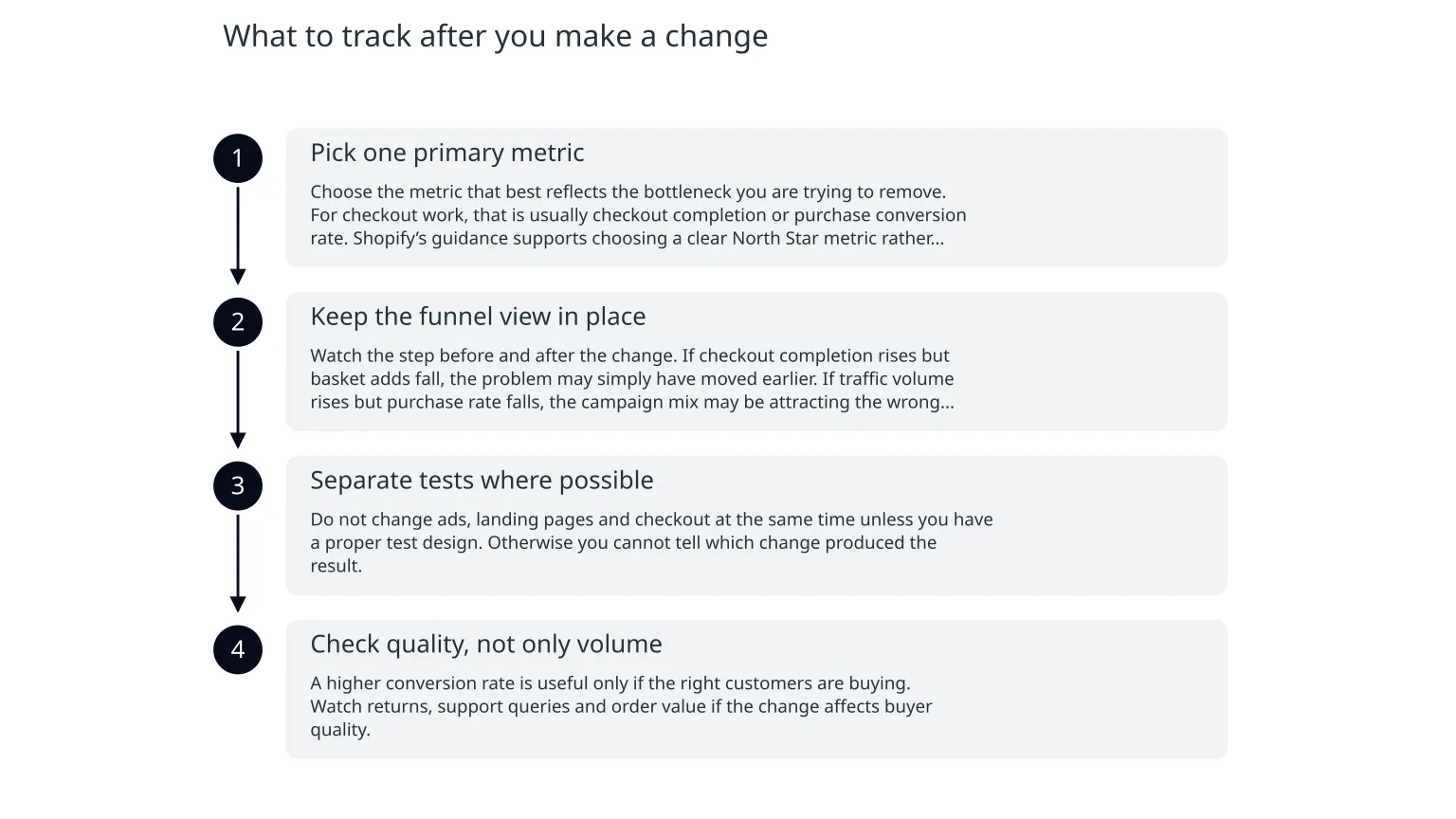
Choose the metric that best reflects the bottleneck you are trying to remove. For checkout work, that is usually checkout completion or purchase conversion rate. Shopify’s guidance supports choosing a clear North Star metric rather than chasing every number at once.
- 2
Keep the funnel view in place
Watch the step before and after the change. If checkout completion rises but basket adds fall, the problem may simply have moved earlier. If traffic volume rises but purchase rate falls, the campaign mix may be attracting the wrong audience.
- 3
Separate tests where possible
Do not change ads, landing pages and checkout at the same time unless you have a proper test design. Otherwise you cannot tell which change produced the result.
- 4
Check quality, not only volume
A higher conversion rate is useful only if the right customers are buying. Watch returns, support queries and order value if the change affects buyer quality.
- Use funnel order to decide where the leak is most likely to be.
- Weak traffic, weak intent and weak checkout need different fixes.
- Checkout optimisation is valuable when shoppers want to buy but get stuck at the end.
- Shipping clarity, form burden and payment friction are common places to look first.
- Measure one change at a time so you can trust the result.
When specialist help is useful
If you already have the data but cannot agree on what it means, outside help can be useful. A small diagnostic review can map the funnel, identify the biggest drop-off point and turn that into a short list of practical changes. That is often more useful than jumping straight into a redesign or buying more traffic.
For teams that need a clearer picture before rebuilding a product page, checkout flow or campaign reporting setup, support can also help with measurement design, UX changes and implementation. The aim should be a better decision, not a bigger project.

About the author
Nixim Team, Product Engineering
Practical guidance from Nixim on building software, working with AI and running dependable cloud systems.