
Founder checklist: what to set up before Companies House identity verification reaches more filings
A practical checklist for UK founders on who needs identity verification, how to track personal codes, and how to keep filing ownership clear before deadline pressure creates avoidable mistakes.

On this page
1. Who2. Codes3. Filing4. Timing5. Filing route6. Agent7. ReviewTakeawaysIn short
- Directors and PSCs both need a verified identity in the Companies House process.
- Keep each personal code with the right filing record, not in a random inbox thread.
- Assign one clear owner for confirmation statements, incorporations and PSC updates.
- If someone is both a director and a PSC, the same verified identity can link to both roles.
- If an external filer acts for you, check what authorisation they need and when it applies.
Companies House identity verification is no longer something founders can treat as background admin. If you run a company, own part of it, or help file on its behalf, you need a simple internal process so the right person verifies at the right time and the right code reaches the right filing. The useful question is not whether the rules are changing in theory. It is how to avoid a blocked confirmation statement, a missed incorporation step, or a scramble to find someone’s personal code at the last minute. The checklist below is aimed at founders, directors and business owners who manage filings directly or through an administrator.
Start by mapping who actually needs to verify
Build the role list first
The simplest way to reduce filing problems is to start with people, not forms. Companies House says identity verification applies to people who set up, run, own or control a UK company. In practice, that means you should list every current director and every person with significant control, then check whether anyone else is involved in filing or control decisions.
- Current directors
- People with significant control (PSCs)
- Anyone preparing filings on the company’s behalf
- Anyone joining or leaving a role soon
Treat personal codes as filing data, not personal gossip
Keep a secure record
Once identity verification is completed, each person receives a Companies House personal code. That code is not something to leave in a chat thread or buried in an email inbox. Store it in a secure, internal record that the filing owner can reach when needed, and keep it separate from unrelated company admin.
0 of 5 complete
Assign one clear person to file
Do not leave ownership vague
The filing process becomes easier when one person is clearly responsible for each task. For many founders, that will be a director, finance lead, administrator or external adviser. The important point is that the business knows who will submit the confirmation statement, who will update PSC information, and who will provide or enter the relevant personal code at the right time.
Clear owner
One named person knows the deadline, has the code and understands the role being filed. Questions are routed quickly and the filing is less likely to stall.
Vague ownership
Several people assume someone else will do it. That creates delay, especially if the director, PSC or external filer is unavailable when the deadline arrives.
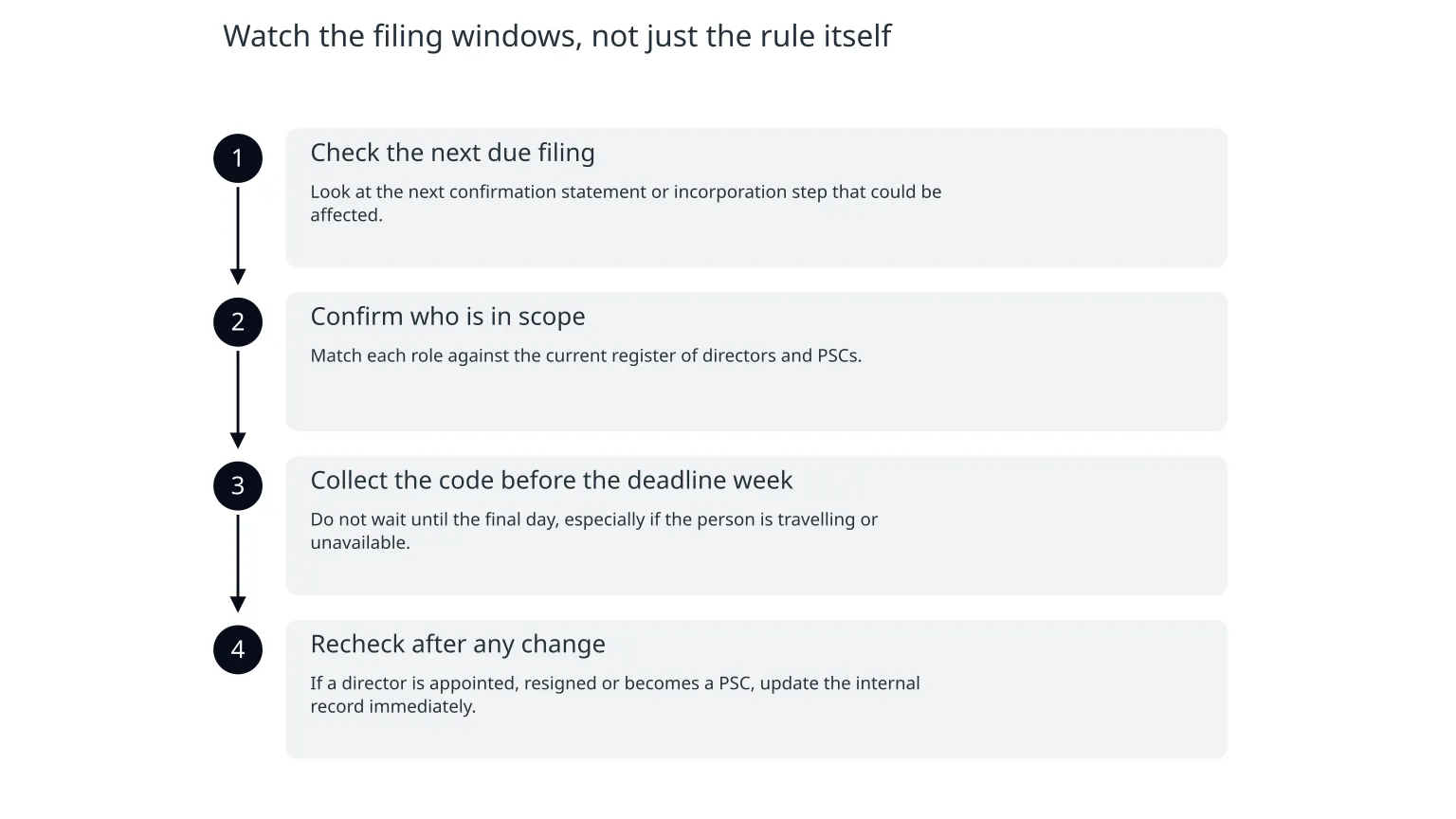
Watch the filing windows, not just the rule itself
Different roles can have different deadlines
Directors must provide their personal code with the company’s next confirmation statement, and new incorporations also require each director’s code. PSCs must also verify, and the relevant filing window depends on the role and when they were added to the register. That means timing matters as much as the verification itself.
- 1
Check the next due filing
Look at the next confirmation statement or incorporation step that could be affected.
- 2
Confirm who is in scope
Match each role against the current register of directors and PSCs.
- 3
Collect the code before the deadline week
Do not wait until the final day, especially if the person is travelling or unavailable.
- 4
Recheck after any change
If a director is appointed, resigned or becomes a PSC, update the internal record immediately.
Check how your filing will be submitted
Not every filing route is the same
Companies House says identity verification can be completed through GOV.UK One Login or through an Authorised Corporate Service Provider (ACSP), and that One Login verification is free. If you use an external accountant, formation agent or other filer, check whether they are acting through the right route and what they need from you in advance.
- Confirm whether the company will file itself or use an external filer.
- Ask what proof or authorisation the filer needs.
- Check whether the same person is acting as director, PSC and filing contact.
- Make sure the person who holds the code is not the same person who controls access to the only copy of the filing notes.
If someone files for you, plan for the new authorisation step
Do not assume old arrangements will continue unchanged
Companies House says future filing-by-agents measures will require businesses to register as authorised agents to file on behalf of clients, and that the earlier 2026 timing was postponed to no earlier than November 2026. Founders do not need to overreact, but they should avoid assuming that current informal habits will last indefinitely.
What to do now
Review who currently files for the company and how they are authorised.What to keep handy
A current list of directors, PSCs and filing contacts.What to ask
Whether your external filer expects a new authorisation step later in 2026 or beyond.What not to do
Wait until a deadline week to discover that the filing route has changed.Build a simple internal check before every filing date
Use a repeatable checklist
This is one of those compliance tasks that works best when it is boring. The more repeatable your internal process is, the less likely you are to lose time searching for details. A founder-friendly process can fit on one page and be reused each time a filing is due.
0 of 6 complete
Use specialist help when the process is not simple
If your company has several directors, changing PSCs, a holding structure, or an external filer handling multiple entities, a short review with a specialist can be useful. The value is usually in process clarity: who does what, where the code lives, and which filing path is being used. That is a practical support need, not a legal theory exercise.
What to do next
- Map directors, PSCs and anyone who files on your behalf.
- Store personal codes securely and link them to the right role.
- Assign a clear filing owner for each deadline.
- Check the submission route early, especially if an external filer is involved.
- Revisit the process whenever roles or ownership change.
Closing thought
The goal is not to build a heavy compliance system. It is to make sure identity verification does not become a last-minute blocker for routine company filings. A small amount of structure now is usually enough to keep the process moving later.

About the author
Nixim Team, Product Engineering
Practical guidance from Nixim on building software, working with AI and running dependable cloud systems.