
Founders’ Relief: what to check now in your records, ownership and exit plan
A practical guide for founders on what to review now if Founders’ Relief goes ahead: ownership records, share history, company evidence and exit planning. The focus is on decision-making, not tax theory.

On this page
Why it mattersWhat to checkRecordsPlanningSafeguardsNext stepsIn short
- Check your cap table, share issuances and any side agreements now.
- Make sure company records match the real ownership story, not just a spreadsheet.
- Identify any gaps in board minutes, filings or share transfer paperwork.
- Review whether future fundraising or option grants could affect eligibility.
- Treat exit planning as a records and governance exercise, not only a tax one.
The UK government’s Founders’ Relief consultation creates an immediate practical question for founders: what should you check now, before any rules are finalised? The short answer is that this is less about learning tax theory and more about protecting options. If the relief is introduced, the founders who benefit will likely be the ones who can show a clear paper trail, a clean ownership history and a sensible plan for how they might exit later.
That means now is the time to look at records, not just valuations. It also means checking assumptions you may have made informally about who owns what, when shares were issued and whether company documents are consistent with reality.
Why this consultation is a founder planning issue
HM Treasury has opened a consultation on Founders’ Relief, with a proposed 10% Capital Gains Tax rate on qualifying share disposals and a £10 million lifetime limit, intended to apply to qualifying disposals made on or after 6 April 2027. That is useful context, but the practical decision for founders is simpler: if you may one day sell or transfer shares, can you prove you qualified?
The proposed relief is not a reason to change your business just for tax reasons. It is a reason to tighten the way you already record ownership, control and company history. If the eventual rules include detailed eligibility checks, weak records can become a problem long before any sale is on the table.
What founders should review now
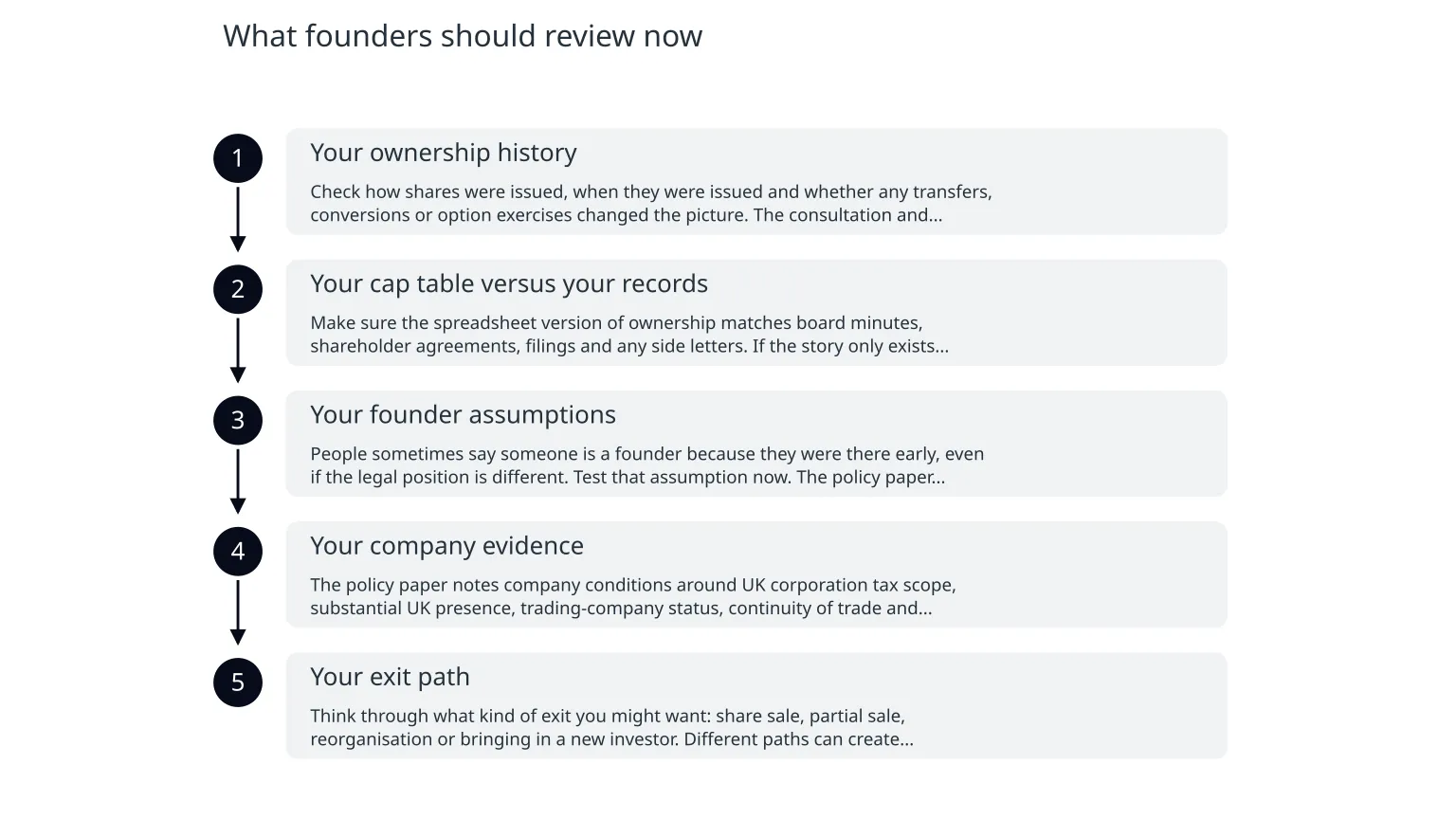
- 1
Your ownership history
Check how shares were issued, when they were issued and whether any transfers, conversions or option exercises changed the picture. The consultation and policy paper both point to conditions around founder status and share holding periods, so you need a reliable timeline.
- 2
Your cap table versus your records
Make sure the spreadsheet version of ownership matches board minutes, shareholder agreements, filings and any side letters. If the story only exists in one place, it is fragile.
- 3
Your founder assumptions
People sometimes say someone is a founder because they were there early, even if the legal position is different. Test that assumption now. The policy paper refers to conditions around holding ordinary shares and being a founder at the point trading started.
- 4
Your company evidence
The policy paper notes company conditions around UK corporation tax scope, substantial UK presence, trading-company status, continuity of trade and growth thresholds. You do not need to write a tax memo yourself, but you should be able to find the documents that show how the business evolved.
- 5
Your exit path
Think through what kind of exit you might want: share sale, partial sale, reorganisation or bringing in a new investor. Different paths can create different paperwork and timing issues. Planning early gives you more choices later.
Records that are worth tightening now
Good enough
A single cap table, updated occasionally, with no obvious disputes.
Better
A reconciled set of records: cap table, filings, share certificates, board minutes, option paperwork and a short written ownership timeline.
If you want a simple rule, use this: anything that affects ownership should be recorded in more than one place, and those places should agree. That includes share allotments, transfers, option grants, vesting changes, investor rights and any amendments to shareholder terms.
- Keep a dated ownership timeline from incorporation onwards.
- Store board and shareholder approvals alongside the transaction that needed them.
- Review whether any historic transfers were completed properly.
- Check whether option grants, vesting and exercise records are complete.
- Confirm who currently has access to company records and whether that would still work if a new adviser, buyer or investor needed to review them.
How early planning affects future options
The consultation is about future relief, but the benefits of preparation are broader. Clean records make fundraising smoother, reduce the chance of disputes and help advisers answer questions faster. They also make it easier to see whether a planned transaction could unintentionally reduce eligibility later.
If you ignore this now
You may discover gaps only when a buyer, investor or tax adviser asks for evidence. That can slow a deal and leave you scrambling for historic approvals or missing paperwork.
If you prepare now
You can review the evidence calmly, fix inconsistencies early and keep more exit routes open. Even if the final relief rules change, the governance work still helps.
There is also a trade-off worth being honest about: tidy records take time. For a busy founder, that can feel like back-office work that does not move the product forward. But compared with reconstructing ownership history years later, the effort is usually much smaller.
Practical safeguards and common mistakes
0 of 5 complete
A common mistake is to treat this as a one-off compliance task. It is better understood as a living governance process. Whenever ownership changes, update the record set immediately. Whenever you raise money, grant options or reorganise the business, revisit the founder story and see whether the facts still line up.
A simple next-step plan for founders
- 1
Collect the core documents
Pull together the cap table, incorporation documents, share certificates, board minutes, option paperwork, shareholder agreements and any side letters.
- 2
Write the ownership story
Create a short timeline of what happened, when it happened and why. Keep it factual and dated.
- 3
Check for mismatches
Compare the timeline against filings and legal documents. Resolve inconsistencies now, while the issues are still small.
- 4
Review likely future events
Ask what could change ownership before exit: new funding, option grants, reorganisation or secondary sales.
- 5
Speak to the right adviser
If the company is preparing a raise, restructuring or eventual sale, ask a tax adviser and solicitor to review the ownership position and the transaction plan together.
If you are also planning a product change, a systems rebuild or a data cleanup, this is a good moment to tidy the company records that sit behind those decisions. Founders’ Relief may be a tax consultation, but the preparation is mostly about clarity, control and future flexibility.

About the author
Nixim Team, Product Engineering
Practical guidance from Nixim on building software, working with AI and running dependable cloud systems.