
How founders can scope an AI pilot for cost control, guardrails and less waste
A practical checklist for founders planning an AI pilot: how to use service-tier controls, prompt caching and clear approval points to keep scope tight without blocking useful learning.

On this page
Why scope mattersChecklistControlsGovernanceTrade-offsNext stepsIn short
- Scope the pilot around one decision, not a vague ambition.
- Use service-tier limits to stop accidental spend or capability creep.
- Design prompts for reuse if you want caching to help.
- Add human approval where a mistake would cost time, money or trust.
- Measure usefulness, not just usage.
If you are a founder evaluating an AI pilot, the hard part is usually not the model choice. It is deciding what the pilot is allowed to do, what it must never do, and how you will stop small experiments turning into large bills. Recent platform changes make that governance more deliberate: projects can be limited to approved service tiers, and prompt caching can help reduce repeat work when the request shape stays stable.
That is useful, but only if the pilot is scoped with discipline. A good pilot should answer one business question, protect users from avoidable mistakes, and leave you with enough evidence to decide whether to continue, change direction or stop.
Why founders should govern the pilot before they optimise it
Many teams start with the question “What can this AI do?” A better first question is “What is this pilot allowed to change?” If the answer is unclear, the project can drift into more usage, more edge cases and more cost before you have learned anything useful.
OpenAI’s current documentation is a reminder that governance is now part of the product surface. Projects can be restricted to certain service tiers, and prompt caching can change the cost and latency profile of repeated requests. Those controls help, but they do not replace a clear pilot design.
Founder checklist for an AI pilot
0 of 8 complete
How platform settings help without doing the thinking for you
Service-tier limits
Useful for preventing accidental use of capabilities you did not intend to pilot. They help keep the experiment inside an agreed budget and technical boundary.
Prompt caching
Useful when you repeat a stable prompt prefix, because the system can reuse work and lower latency and input-token cost on cache hits.
The important caveat is that neither control guarantees the result you want. A project can be allowed to use a tier and still remain poorly scoped. A prompt can be cache-friendly and still produce the wrong output. And a session can continue without guaranteeing a cache hit.
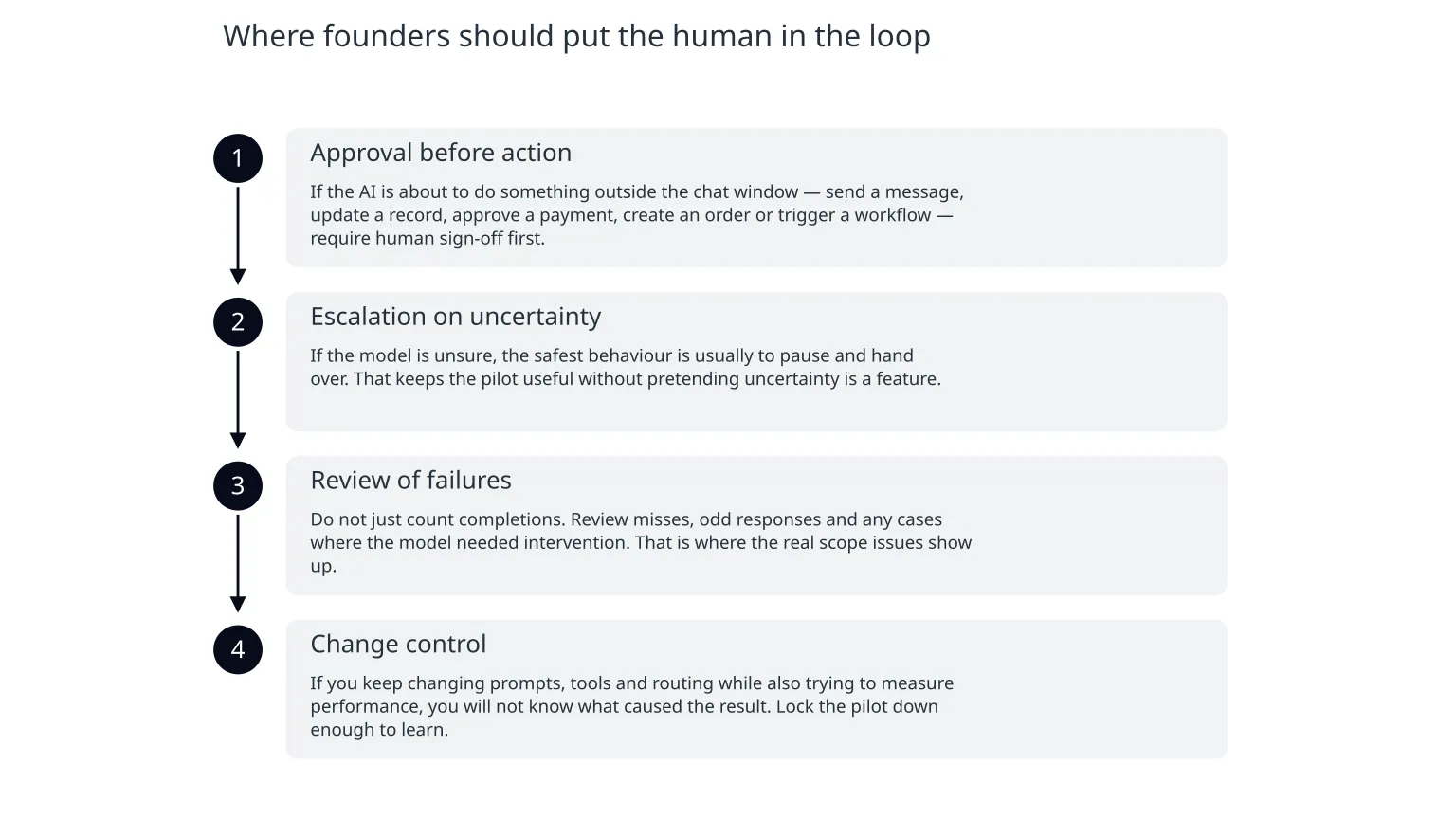
Where founders should put the human in the loop
- 1
Approval before action
If the AI is about to do something outside the chat window — send a message, update a record, approve a payment, create an order or trigger a workflow — require human sign-off first.
- 2
Escalation on uncertainty
If the model is unsure, the safest behaviour is usually to pause and hand over. That keeps the pilot useful without pretending uncertainty is a feature.
- 3
Review of failures
Do not just count completions. Review misses, odd responses and any cases where the model needed intervention. That is where the real scope issues show up.
- 4
Change control
If you keep changing prompts, tools and routing while also trying to measure performance, you will not know what caused the result. Lock the pilot down enough to learn.
The trade-offs founders should expect
Tighter scope
Usually means less surprise, clearer measurement and lower risk. The trade-off is that you may leave some useful capability out of the first version.
Looser scope
May show more impressive demos, but it tends to blur the learning and increases the chance of cost creep, inconsistent behaviour and hard-to-explain outcomes.
There is also a timing trade-off. If you spend too long designing the perfect pilot, you delay learning. If you move too quickly, you may build around the wrong assumption. The practical middle ground is a small, governed pilot with enough realism to matter.
What to do before you commit to a build
- Write the pilot question in one sentence.
- List the exact actions the AI may and may not take.
- Choose the smallest allowed capability set that can still answer the question.
- Decide what you will measure after the first week, not just at the end.
- Review whether prompt structure can stay stable enough for caching to help.
- Add a clear handoff path to a person before any customer-visible action.
If you want help shaping the scope, it is usually worth bringing in specialist support when the pilot touches multiple systems, customer data or operational approvals. That is less about buying more technology and more about avoiding a pilot that looks active but never produces a decision you can trust.

About the author
Nixim Team, Product Engineering
Practical guidance from Nixim on building software, working with AI and running dependable cloud systems.