
How to validate recovery before a real outage forces the issue
A practical guide to testing recovery before an incident happens, with a simple order of operations for teams that want clearer evidence than a vague disaster-recovery plan.

On this page
Why testWhat firstChoose testsRun itCheck and improveIn short
- Start with the failure most likely to hurt customers or revenue.
- Use the lightest test that proves recovery, not the biggest one you can imagine.
- Judge success by service health and business outcomes, not individual servers.
- Add more complex tests only after the first pass/fail signal is clear.
Many teams say they have disaster recovery covered, but have never tested the part that matters most: whether the business can recover in time. The useful question is not whether a plan exists on paper. It is whether a failure can be simulated, observed and recovered from before customers feel the impact. AWS’s recent resilience guidance pushes in that direction by favouring preconfigured tests and outcome-based pass or fail checks rather than vague statements about being “DR ready”.
That is a sensible shift, but it only helps if you choose tests that match the system you actually run. A small web app, a data platform and a customer-facing workflow do not need the same recovery exercise. Start with the failure mode most likely to hurt the business, then test the smallest realistic step that proves recovery works.
Why a recovery plan is not enough
A recovery plan is a useful starting point, but it does not prove anything until it is tested. AWS’s reliability guidance says testing is the only way to know whether a workload will operate as designed, and recommends regular game days to simulate failures and team responses. That is the core problem: paper plans often assume people, systems and dependencies behave exactly as expected. Real incidents rarely do.
For founders, CTOs and operations teams, the practical goal is not to run every possible disaster scenario. It is to learn whether the system can recover within the time the business can tolerate. If you cannot say which user journey, service or integration matters most, then the first test is not technical at all. It is deciding what failure would hurt the business fastest.
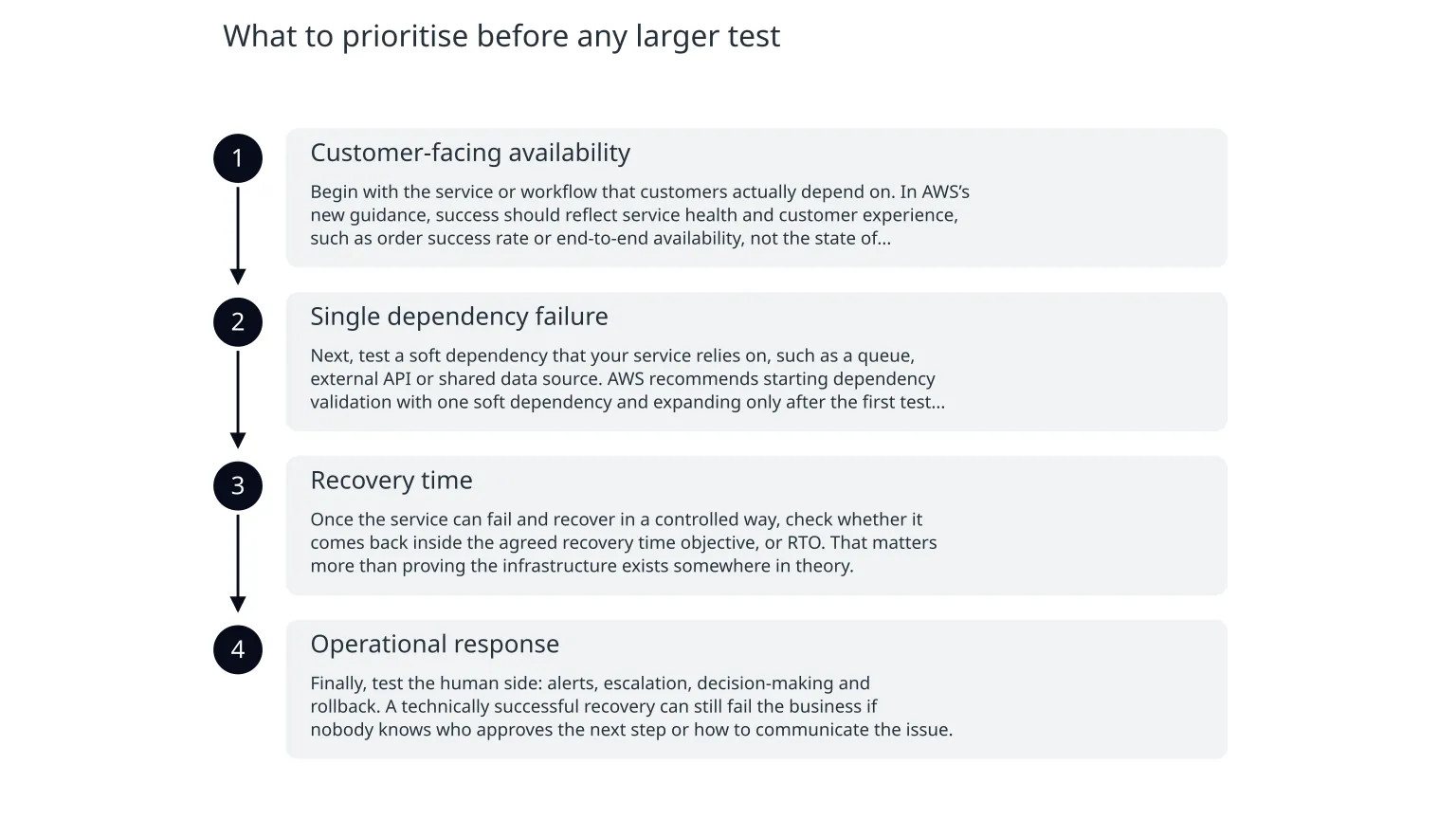
What to prioritise before any larger test
- 1
Customer-facing availability
Begin with the service or workflow that customers actually depend on. In AWS’s new guidance, success should reflect service health and customer experience, such as order success rate or end-to-end availability, not the state of individual resources.
- 2
Single dependency failure
Next, test a soft dependency that your service relies on, such as a queue, external API or shared data source. AWS recommends starting dependency validation with one soft dependency and expanding only after the first test gives a clear signal.
- 3
Recovery time
Once the service can fail and recover in a controlled way, check whether it comes back inside the agreed recovery time objective, or RTO. That matters more than proving the infrastructure exists somewhere in theory.
- 4
Operational response
Finally, test the human side: alerts, escalation, decision-making and rollback. A technically successful recovery can still fail the business if nobody knows who approves the next step or how to communicate the issue.
How to choose the right test for the system you have
Availability Zone recovery
Useful when a service must survive the loss of one zone. This is a good first resilience exercise for systems already designed to spread across zones and recover automatically.
Dependency validation
Useful when the riskiest part is a single upstream service, queue or API. It helps you see whether the system degrades gracefully, retries sensibly and surfaces the right alert.
Multi-Region isolation
Useful when regional failure would be a real business event. This is more complex and should come after you know your recovery objectives and failover dependencies.
Multi-Region recovery
Useful when you need to prove the full failover path, not just isolated components. It is the heaviest of the four AWS-recommended tests and should be reserved for systems where the effort is justified by the risk.
AWS’s current guidance names four recommended tests: Availability Zone recovery, Dependency validation, Multi-Region isolation and Multi-Region recovery. The important part is not the label, but the fit. If your product is still early-stage, a heavy multi-region exercise may be premature. If your business depends on uninterrupted customer transactions, a simple zone-level check may not be enough.
- Start with one clear business outcome to protect.
- Prefer a test that can be repeated regularly.
- Make the test small enough to understand, but real enough to surface genuine dependencies.
- Define pass/fail before you run it, so the result is not debated afterwards.
- Record what failed, what recovered automatically and what needed manual intervention.
A simple test sequence you can actually use
- 1
Pick one critical journey
For example, checkout, login, order updates, support ticket creation or document upload. Keep it to one journey so the result is readable.
- 2
Write the success criteria
Use measurable outcomes. For example, the journey must stay available, or it must recover within the agreed RTO. If the test is about sustained operation, the thresholds should hold throughout the test.
- 3
Simulate the smallest realistic failure
That might be disabling a dependency, shifting traffic, or failing over one component in a controlled environment. Avoid broad disruption on the first attempt.
- 4
Watch the customer path
Do not stop at infrastructure health checks. Confirm whether users can still complete the task, whether alerts fired, and whether the team knew what to do.
- 5
Capture the gaps
Document any missing runbooks, unclear ownership, delayed alerts, manual workarounds or settings that slowed recovery.
- 6
Repeat after fixes
A single successful test is not enough. Re-test after changes so you know the improvement holds.
Common mistakes and practical safeguards
- Do not confuse backup availability with recovery readiness.
- Do not use vague language like “fully resilient” unless you can point to a specific tested scenario.
- Do not run a complex failover before you know what you are trying to prove.
- Do not measure success only by system status if customers still could not complete the task.
For teams building on AWS, this is also where the platform’s resilience tools can help structure the work. AWS Resilience Hub now supports recommended experiments and scores applications partly through testing activity. That can make the exercise more systematic, but it does not replace judgement. The platform can help you run the test; it cannot decide whether the test reflects your real business risk.

About the author
Nixim Team, Product Engineering
Practical guidance from Nixim on building software, working with AI and running dependable cloud systems.