
Prototype, live MVP or pilot: which format is enough to test your idea?
A practical guide for founders and early product teams choosing the lightest first release that can still test demand and usability honestly. It explains what prototypes, live MVPs and pilots each prove, where they go wrong, and how to pick the next step without overbuilding.

On this page
WhyCompareDecideExamplesRisksSafeguardsNextIn short
- A prototype helps you test an idea, workflow or user need before building a complete product.
- A live MVP is a small but usable product that tests real demand with real users.
- A pilot is useful when you want to trial a rougher release with a limited audience and learn in context.
- Pick the smallest format that can answer your most important question honestly.
- If you cannot say what you will learn, you are probably building too much.
Not every first release needs to be a full MVP. Sometimes the right move is a prototype, sometimes a narrow live MVP, and sometimes a pilot with a small group of real users. The key is to choose the format that tests your riskiest assumption with the least unnecessary work.
This matters because early-stage teams often overbuild. They add features to reduce anxiety, not to learn faster. A better approach is to ask a simpler question: what do we need to prove about demand, usability or willingness to pay before we invest further?
Start with the question, not the build
An MVP is often described as the smallest version of a product that can still be brought to market and used to test a business idea. That is useful, but it can still leave teams asking the wrong question. They start by estimating scope, when they should start by identifying the risk they need to reduce.
If your biggest uncertainty is whether people understand the problem, a prototype may be enough. If your uncertainty is whether they will actually use and pay for a working solution, you need a live MVP. If your uncertainty is whether a rougher version works in the real world with a limited group, a pilot may be the better label and format.
What each format is really for
Prototype
Best when you need to validate a problem, a workflow or a concept before full build. It can be clickable, visual or partially functional. It is meant to help you learn, not impress users with completeness.
Live MVP or pilot
Best when you need real usage in a real environment. A live MVP should be complete enough to deliver the core value. A pilot can be helpful when you want a small, bounded rollout with selected users who understand they are part of an early release.
| Format | What it proves | When it fits | Main risk |
|---|---|---|---|
| Prototype | Whether the problem, flow or interface makes sense | You need fast learning before coding much | Mistaking interest for demand |
| Live MVP | Whether people will use the core product in practice | You need real behaviour, not just feedback | Adding too many features too soon |
| Pilot | Whether the product works in a controlled real-world trial | You want a limited rollout with tolerant users | Confusing a trial audience with the full market |
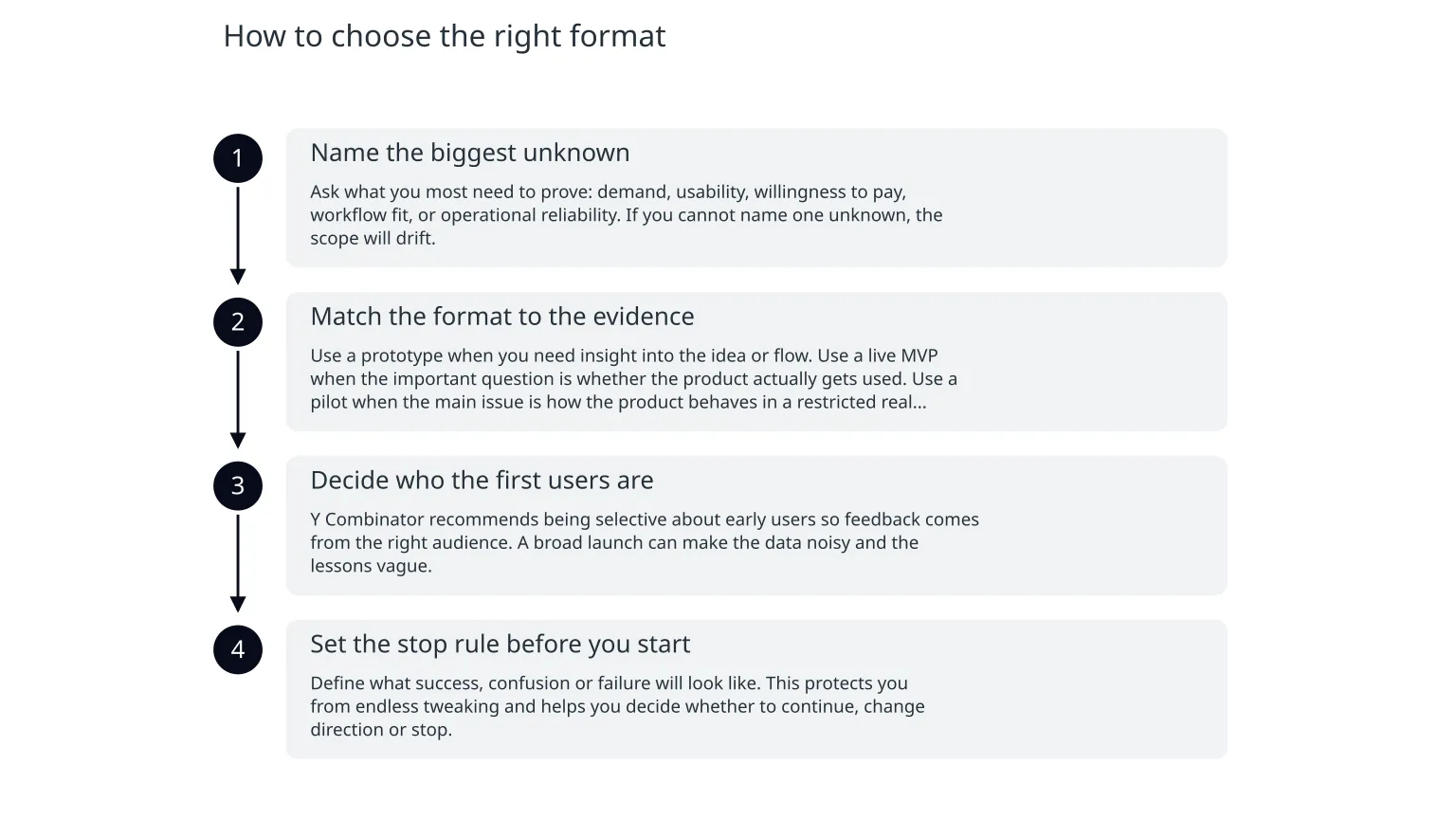
How to choose the right format
- 1
Name the biggest unknown
Ask what you most need to prove: demand, usability, willingness to pay, workflow fit, or operational reliability. If you cannot name one unknown, the scope will drift.
- 2
Match the format to the evidence
Use a prototype when you need insight into the idea or flow. Use a live MVP when the important question is whether the product actually gets used. Use a pilot when the main issue is how the product behaves in a restricted real setting.
- 3
Decide who the first users are
Y Combinator recommends being selective about early users so feedback comes from the right audience. A broad launch can make the data noisy and the lessons vague.
- 4
Set the stop rule before you start
Define what success, confusion or failure will look like. This protects you from endless tweaking and helps you decide whether to continue, change direction or stop.
Illustrative choices for common founder questions
If you only need to test understanding
Illustrative example: you want to know whether users understand a new ordering flow. A clickable prototype may be enough. You can show the flow, watch people try it, and learn where they hesitate without building the full backend.
If you need to test real use
Illustrative example: you want to know whether businesses will actually submit documents through your product each week. A live MVP is better, because you need working input, output and enough reliability to observe real behaviour.
If you need a controlled rollout
Illustrative example: you are launching to a small group of design partners who accept rough edges. A pilot can help you learn in context, especially when support, feedback and iteration are part of the plan.
If you need proof of willingness to pay
Illustrative example: if the real question is whether someone will pay for the outcome, make sure your format reaches the point of commitment. A polished prototype may attract interest, but a paid pilot or live MVP gives stronger evidence.
Where teams misuse MVPs
- Building a full product and calling it an MVP.
- Using a prototype to answer a demand question it was never meant to answer.
- Treating friendly feedback as market proof.
- Launching too early without support, logs or ownership.
- Adding features because they feel reassuring, not because they change the decision.
How to keep the first release honest
0 of 6 complete
Business.gov.uk notes that an MVP should be a cost-effective way to test the market and improve the idea, and it cautions teams not to exceed the MVP budget. That is as much a planning discipline as a product one. If the scope grows without a clear reason, the test becomes harder to trust.
The right format also helps with expectations. Calling something a pilot can make rough edges easier to accept when the goal is learning in a limited setting. But a pilot should still be designed carefully, with clear feedback routes and a decision about what happens after the trial.
What to do after the first test
- If the problem is unclear, improve the research before adding features.
- If the workflow works but adoption is weak, revisit positioning or user fit.
- If the core value is proven, build only the next constraint that blocks wider use.
- If the release failed to produce clear evidence, simplify the question and try again.
Y Combinator’s guidance is blunt but useful: early products often do not solve the problem well at first, and that is fine if you are learning quickly. The goal is not to ship your final vision immediately. The goal is to find out whether the idea deserves more investment.

About the author
Nixim Team, Product Engineering
Practical guidance from Nixim on building software, working with AI and running dependable cloud systems.