
Prototype, pilot or MVP: how to choose the lightest test that still answers the real question
Founders do not need the biggest first build. They need the lightest test that can prove, or disprove, the riskiest assumption with enough evidence to decide what happens next.

On this page
StartCompareSpeedEvidenceChooseRisksPracticalCloseIn short
- Prototype = quickest way to test understanding, flow or usability.
- Pilot = best when you need evidence in a real environment with limited users.
- MVP = best when you need to learn whether people will actually use or pay for the thing.
- The lightest useful test is usually the best starting point.
- Define success measures before you build anything.
A lot of teams jump straight to a full MVP when a cheaper test would answer the real question sooner. If you are deciding where to spend the first meaningful budget, the key is not how complete the thing looks. It is whether the test will give you enough evidence to make the next decision with confidence.
In simple terms: a prototype shows the idea, a pilot shows it in a real setting, and an MVP proves whether the product deserves to exist in the first place. The right choice depends on the riskiest assumption, not on how polished the build feels.
Start with the question, not the format
When founders ask whether they need a prototype, pilot or MVP, the wrong starting point is usually the format itself. The better question is: what is the single riskiest assumption we need to test first? That might be demand, usability, operational fit, pricing, or whether the team can actually deliver the service reliably.
Government guidance on testing and iterating is clear on the principle: use testing to reduce risk before investing more time and money, and decide in advance what counts as success so the learning leads to a decision rather than a vague experiment.
Prototype, pilot and MVP compared
Prototype
Fastest and cheapest. Best for showing an idea, checking whether users understand it, or testing a workflow on paper or with a simple clickable mock-up. A prototype is usually not meant to be production-ready. It helps you learn before you build.
Pilot
A small real-world trial with limited users, a narrow scope or a single team. A pilot sits closer to reality than a prototype, so it can reveal process issues, support load, edge cases and operational friction. It is useful when the service or system has to work in context before you scale it.
MVP
The lightest usable version of the product that can test your core assumption with real users. An MVP should do one valuable thing well enough to answer whether the idea deserves further investment. It should not try to prove everything at once.
How they differ
The main difference is evidence quality versus build effort. Prototypes are quickest, pilots are more realistic, and MVPs are the best fit when you need live behaviour from real users to decide whether the product should continue.
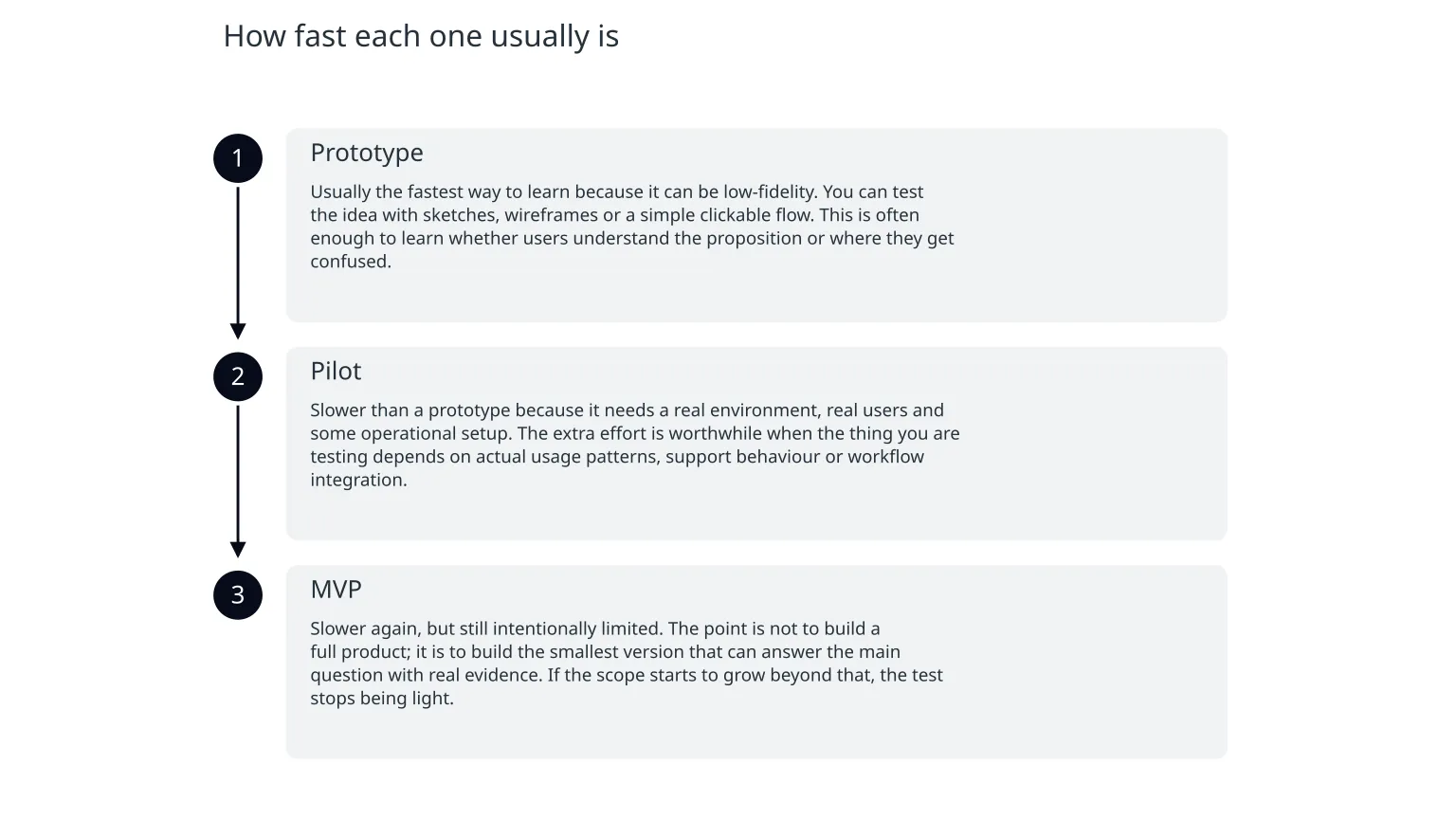
How fast each one usually is
- 1
Prototype
Usually the fastest way to learn because it can be low-fidelity. You can test the idea with sketches, wireframes or a simple clickable flow. This is often enough to learn whether users understand the proposition or where they get confused.
- 2
Pilot
Slower than a prototype because it needs a real environment, real users and some operational setup. The extra effort is worthwhile when the thing you are testing depends on actual usage patterns, support behaviour or workflow integration.
- 3
MVP
Slower again, but still intentionally limited. The point is not to build a full product; it is to build the smallest version that can answer the main question with real evidence. If the scope starts to grow beyond that, the test stops being light.
Which format gives the best evidence?
The strongest evidence usually comes from the format that most closely matches the decision you need to make. If you are deciding whether users understand the concept, a prototype may be enough. If you are deciding whether the idea works in day-to-day operations, a pilot is stronger. If you are deciding whether to invest in the product at all, an MVP often gives the most relevant evidence because it shows actual usage, not just stated interest.
Local Digital guidance notes that prototyping can begin with low-fidelity tools and simple assumptions testing before moving to richer mock-ups. GOV.UK guidance also encourages teams to develop prototypes quickly and cheaply, and to test carefully with customers.
How to choose the lightest test
0 of 6 complete
Illustrative example: if you want to know whether customers would use an AI assistant to answer a common question, a prototype might be enough to test the conversation flow. If you need to know whether it can safely sit inside your support process, a pilot is more appropriate. If you need to know whether the product should exist as a standalone offer, a true MVP is usually the better test.
What can go wrong if you pick the wrong format
Too much build
Teams often jump to an MVP when they really need a prototype. That adds cost, time and decision fatigue before the riskiest assumption has been tested.
Too little realism
On the other hand, some teams stop at a nice-looking prototype when the real problem is operational. In that case, the team learns very little about support load, errors or handoff points.
There is also a softer failure mode: calling something an MVP when it is really just an internal demo. That can create false confidence because the team has built software, but not yet tested the behaviour that matters.
The safest approach is to treat each format as a learning tool with a clear boundary. A prototype is not supposed to settle every business question. A pilot is not supposed to become a half-hidden production service. An MVP is not supposed to become a full platform by accident.
What a good first test looks like
One question
Pick one assumption to test, not five.One audience
Use the smallest realistic group you can.One measure
Decide what success will look like before you start.One boundary
Define what will not be built yet.One review point
Set a date to decide whether to continue, pause or change direction.One owner
Make sure someone is responsible for the decision, not just the build.This is where practical product support can help. The work is not just making the software. It is shaping the test so the evidence is useful. That may mean a clickable prototype, a narrow pilot, or a small MVP with live users, analytics and a clean handover path.
A sensible default
- Start with the lightest format that can answer the riskiest assumption.
- Use a prototype for understanding and usability questions.
- Use a pilot for real-world operational questions.
- Use an MVP when the market or user-behaviour question needs real usage evidence.
- Define success measures before you start, not after the build is finished.
- Avoid building for completeness when you only need a decision.
If you are choosing today, a good default is this: prototype first when the risk is clarity, pilot first when the risk is operations, and MVP first when the risk is whether the product deserves to exist. That keeps spending aligned to evidence, not optimism.
If you need help turning the question into a scoped test, it is usually worth getting an outside view before you commit to a larger build. The right conversation should focus on the assumption, the evidence you need, and the lightest format that can produce it.

About the author
Nixim Team, Product Engineering
Practical guidance from Nixim on building software, working with AI and running dependable cloud systems.