
Typed answers first, chat later: a better MVP for some ideas
For founders validating an early product idea, a structured typed-answer workflow can be a faster, clearer MVP than a chat interface. It helps you test whether users can make decisions, provide usable inputs and complete the core task before you invest in a more open-ended conversational experience.

On this page
Why it mattersBefore / afterWhat you learnTrade-offsMisuse risksHow to decideNext stepsIn short
- Start with the smallest interface that tests the core decision.
- Typed answers often reduce ambiguity and make results easier to compare.
- Chat can be useful later, but it is easier to overbuild and harder to evaluate.
- If users need free-form explanation or back-and-forth, chat may be the better first step.
- A good MVP should prove value, not just demonstrate that AI works.
A new API release often tempts teams to build the most visible thing first. In this case, the better question is not “can we build chat?” but “what proves the idea fastest?” The recent Decisions API release is a useful prompt because it is built for typed answers, fixed choices and rubric-style decisions rather than open-ended chat. For many early products, that is exactly the kind of constraint that helps you learn sooner.
Why this choice matters before you build
Founders often reach for chat because it feels modern and familiar. But familiar is not the same as useful. If your goal is to validate whether people will use the product, you need the clearest possible path to an answer. A structured workflow can do that by forcing the product to ask only the questions that matter and return a result you can measure.
The Decisions API release is a timely reminder of this. It is designed for typed answers, not free-form conversation, and supports inputs such as text, images and JSON for decisions like probabilities, fixed choices and rubric scores. That makes it a good lens for MVP thinking: what is the minimum interface that helps a real user complete the task?
Before and after: two ways to frame the product
Before: build chat first
You design a conversational interface, add prompts, handle free-form responses and spend time tuning the tone and flow. The product may look impressive, but it is harder to know whether users actually need the conversation or just the outcome.
After: build typed answers first
You ask one question at a time, keep responses structured and return a clear result. You learn quickly whether users can provide the inputs you need, whether the outcome is understandable and where they hesitate.
Illustrative example: imagine a lead-qualification tool for a small sales team. A chat interface might ask broad, open-ended questions and produce a polished summary. A typed workflow might ask for company size, urgency, budget band and use case, then classify the lead. The second version is less flashy, but it is often easier to test, easier to compare and easier to improve.
That difference matters because early validation is usually about reducing uncertainty. Structured inputs make it simpler to see what the user chose, what they skipped and where the logic failed. Chat can hide those signals behind natural language.
What typed workflows help you learn sooner
- Whether users understand the task without explanation.
- Which data points are actually needed to produce a useful result.
- Where users get stuck, hesitate or abandon the flow.
- Whether the result is good enough to be trusted.
- How much manual review you still need before automation is safe enough to expand.
For MVP work, those lessons are valuable because they are concrete. You are not just measuring engagement. You are checking whether the product can collect the right inputs, produce a sensible output and support a business decision.
The trade-offs you should not ignore
Typed answers can be faster to validate
They reduce scope, create clearer data and usually need less interface design. They are also easier to instrument, because every field can be checked and compared.
Chat can be better for messy problems
If users do not yet know what they need, or if the work depends on nuance, conversation can reveal context that a form would miss. In those cases, forcing structure too early can frustrate users.
The danger is building a typed workflow for a problem that genuinely needs dialogue, or building chat when the user simply wants a reliable answer. Either choice can waste time if it does not match the job to be done.
Where teams go wrong
A typed workflow becomes risky when it pretends to be more certain than it is. If the model or rules are making decisions from incomplete information, a clean interface can create false confidence. The output may look precise even when the underlying logic is still brittle.
That is why a good MVP should include visible limits. Tell the user what the system can and cannot do. Keep the first version narrow. If a person needs to review edge cases, make that handoff obvious instead of hiding it behind automation.
- Do not overpromise accuracy just because the interface is tidy.
- Do not remove human review from high-impact decisions too early.
- Do not collect fields you cannot explain or use.
- Do not treat a good demo as proof of a good workflow.
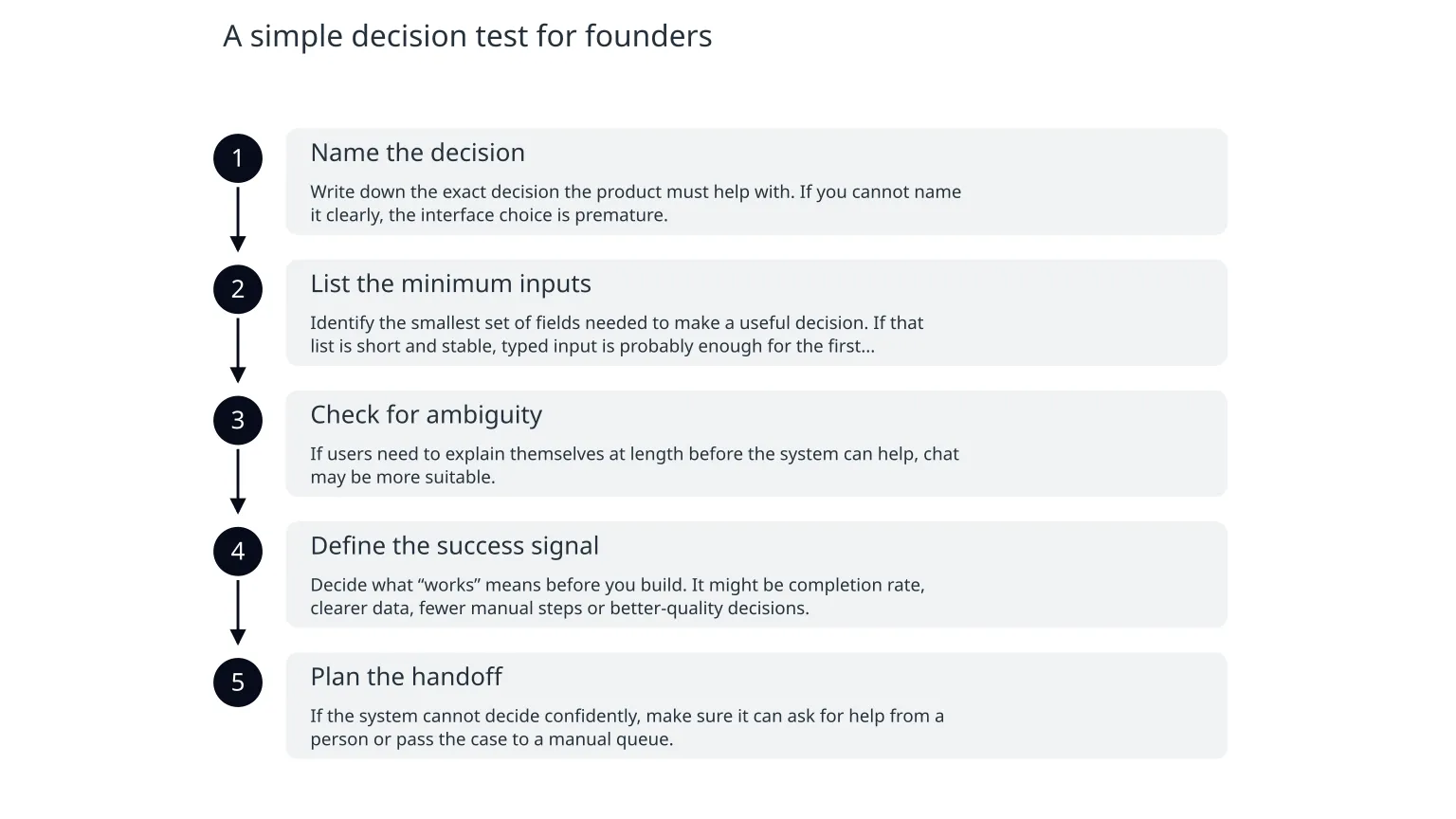
A simple decision test for founders
- 1
Name the decision
Write down the exact decision the product must help with. If you cannot name it clearly, the interface choice is premature.
- 2
List the minimum inputs
Identify the smallest set of fields needed to make a useful decision. If that list is short and stable, typed input is probably enough for the first release.
- 3
Check for ambiguity
If users need to explain themselves at length before the system can help, chat may be more suitable.
- 4
Define the success signal
Decide what “works” means before you build. It might be completion rate, clearer data, fewer manual steps or better-quality decisions.
- 5
Plan the handoff
If the system cannot decide confidently, make sure it can ask for help from a person or pass the case to a manual queue.
A practical next step
If you are validating an early product idea this week, start with the narrowest version that proves the core outcome. Build the typed workflow if the problem is mainly about collecting known inputs and making a structured decision. Choose chat if the problem depends on exploration, context or back-and-forth clarification.
- Choose the interface that best fits the user’s job, not the trend of the moment.
- Use structured inputs when speed, clarity and comparison matter most.
- Use chat when nuance and discovery matter more than rigid structure.
- Keep the first release narrow enough to explain, test and improve quickly.
- Add human review where the cost of a wrong answer is meaningful.
If you want help turning that decision into a scoped MVP, a product engineering partner can help you narrow the workflow, define the first release and avoid building too much before you have evidence. The point is not to make the product clever. The point is to make the learning fast and the scope honest.

About the author
Nixim Team, Product Engineering
Practical guidance from Nixim on building software, working with AI and running dependable cloud systems.