
Useful answers from scattered data without moving everything first
A practical guide to getting search, reporting and AI answers from distributed data using federation, caching and governed access before you commit to a full migration.

On this page
PatternWhy it helpsTrade-offsDecisionSafeguardsNext stepsIn short
- You do not always need one central copy of every dataset before building useful search or AI.
- Federation and cross-cloud querying can reduce duplication and delay, but they add governance and performance questions.
- Caching can lower transfer cost and speed up repeated queries, but it is not the same as full consolidation.
- AI is only useful when access controls, lineage and definitions are clear enough for people to trust the answer.
If your answers are scattered across SaaS tools, cloud platforms and internal systems, the problem is often not the dashboard itself. It is the shape of the data, the access model, and how much you move before anyone can use it. Recent Google Cloud updates around Borderless Lakehouse and Gemini describe a direction many teams are already heading in: query governed data where it lives, reduce movement where possible, and keep permissions and latency in view. That does not remove the need for a warehouse or migration in some cases. It does mean you can choose a smaller first step.
The practical pattern: access first, move later only if needed
For many operations, product and founder teams, the first useful question is not “Which warehouse should we buy?” It is “Where should the answer be computed?” Google Cloud’s Borderless Lakehouse materials describe an open, decentralised approach where analytics engines and AI agents can query cross-cloud, on-premises and SaaS data in place, without forcing everything through ETL pipelines first. That matters when the cost of copying data is high, the source systems change quickly, or the team only needs a few trusted views rather than a complete central replica.
A useful pattern is to separate three layers. First, keep sources of record where they already live. Second, expose governed access to the fields and tables that are actually needed. Third, add caching or replication only for the workloads that prove they need lower latency, lower egress cost, or more stable reporting. Google’s September 2026 update highlights cross-cloud caching as a way to speed up repeated queries and reduce remote transfer costs, but it is described as a preview feature, which is a reminder that this is still an architectural choice, not a universal default.
What this approach gives you
- Less duplicate storage and fewer copies to keep in sync.
- A faster path to useful search or reporting when the business is still validating the question.
- More flexibility if your data lives across AWS, Azure, SaaS tools and internal systems.
- A smaller initial migration surface, which can reduce project risk and rework.
- A clearer way to test whether the business really needs a full central platform.
Google’s October 2026 Gemini update also points to a practical benefit for teams building AI features: models can query certain external sources directly, including Amazon S3, Azure Data Lake, Salesforce Data 360, SAP and Workday, rather than waiting for every record to be copied into one place. For a search tool, support assistant or KPI layer, that can shorten the route from prototype to something people can try.
What you do not get for free
What gets better
Less movement, fewer copies, faster experimentation, and a narrower first build.
What gets harder
You must manage permissions, latency, schema drift, query cost and consistency across systems.
Distributed access is not a shortcut around governance. Google’s documentation emphasises secure access to external cloud data without exposing resources to the public internet, and it refers to governed lakehouse context being exposed to AI models through an MCP server. That tells you the important part: if permissions are weak or definitions are unclear, the model may still be technically connected but operationally unhelpful.
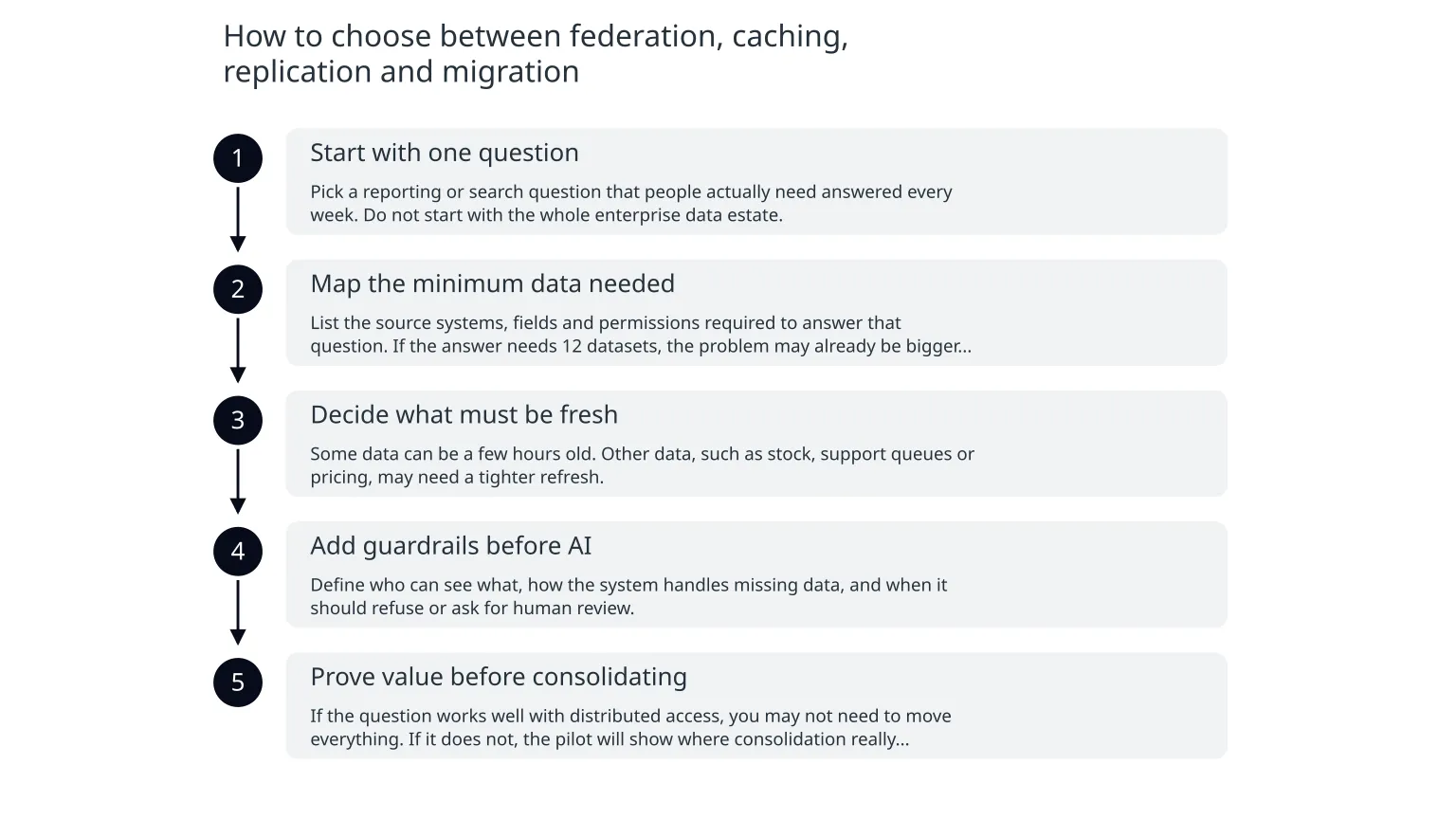
How to choose between federation, caching, replication and migration
| Option | Best when | Main trade-off |
|---|---|---|
| Federation / query in place | You need answers quickly and the number of high-value fields is small | Queries can be slower and governance must be tight |
| Caching | The same cross-cloud data is queried repeatedly | Freshness and cache invalidation need careful control |
| Replication | A subset of data must support frequent reporting or low-latency use | You create another copy to maintain |
| Full migration | The dataset is stable and the business needs one primary analytics environment | Higher upfront effort, but simpler long-term operations |
- 1
Start with one question
Pick a reporting or search question that people actually need answered every week. Do not start with the whole enterprise data estate.
- 2
Map the minimum data needed
List the source systems, fields and permissions required to answer that question. If the answer needs 12 datasets, the problem may already be bigger than a quick pilot.
- 3
Decide what must be fresh
Some data can be a few hours old. Other data, such as stock, support queues or pricing, may need a tighter refresh.
- 4
Add guardrails before AI
Define who can see what, how the system handles missing data, and when it should refuse or ask for human review.
- 5
Prove value before consolidating
If the question works well with distributed access, you may not need to move everything. If it does not, the pilot will show where consolidation really helps.
Practical safeguards for AI over scattered data
0 of 6 complete
A sensible first move
If you are early in the journey, do not start by redesigning the whole data estate. Start with one decision-maker question, one high-value workflow, and one trusted subset of data. Build the smallest governed access layer that can answer it, then check whether the result is fast enough, accurate enough and cheap enough to keep. If not, you will have evidence for the next step instead of a large migration guess.
For teams that need help designing that first layer, this is where data and insights work becomes useful: shaping the access model, reducing movement friction, and making sure AI or reporting uses data in a way the business can trust.

About the author
Nixim Team, Product Engineering
Practical guidance from Nixim on building software, working with AI and running dependable cloud systems.