
What evidence should decide whether your MVP gets scaled, iterated or stopped?
A practical post-MVP framework for founders and product teams to decide whether to scale, change or stop based on evidence thresholds, not feature ideas.

On this page
Why it mattersSet thresholdsWhat to measureDecide what to doCommon mistakesUse a review ritualWhen to get helpIn short
- Decide after the MVP using evidence, not optimism.
- Use a small set of measurable outcomes, not a long feature list.
- Scale when the core outcome is clearly proven and repeatable.
- Iterate when the signal is promising but incomplete.
- Stop when the problem, the solution or the economics do not hold up.
An MVP is not the finish line. It is a learning test. Once it is in front of real users, the important question changes from “what should we build?” to “what did we learn, and what should we do next?” The safest answer is usually not based on enthusiasm. It is based on evidence.
For founders, product leads and non-technical business owners, that means setting decision rules before you get attached to the idea. Good post-MVP decisions are usually one of three things: scale it, change it, or stop it. GOV.UK’s test-and-learn guidance is clear that teams should measure success and use evidence to decide whether to continue, iterate, pause or stop.
Why the next decision matters more than the launch
Many teams treat an MVP as proof that the idea is good. It is not. It is proof that you can put something into the market quickly enough to learn from it. That learning only matters if you use it to make a decision.
The danger after launch is feature drift. You start with a simple goal, then try to satisfy every comment, edge case and internal opinion. That can create a product that is more expensive to run, harder to explain and still not clearly useful.
Business.gov.uk’s validation advice points in the same direction: research the market and understand the demand before committing more resources. The point is not to collect opinions forever. It is to reach a better investment decision.
Start with evidence thresholds, not feature ideas
Before you decide what to build next, define what “good enough” looks like. This does not have to be a complicated model. In most cases, you only need three thresholds:
1. Is the problem real enough that people keep using the product? 2. Is the solution useful enough that they complete the intended action? 3. Is the delivery model sustainable enough that the product can grow without breaking the business?
Scale
The core outcome is clearly working. Users return, complete the key task and the product is worth investing in further.
Iterate
The problem is real, but the experience, scope or positioning needs improvement before more investment makes sense.
Stop
The evidence suggests weak demand, poor fit, unworkable economics or a problem that matters less than first thought.
Pause
The product is not ready for more investment yet, and the team needs more learning before making a bigger call.
GOV.UK says good testing should focus on shared, measurable outcomes and use evidence to guide decisions, not just to prove that a feature was built. That is the key difference. You are not asking, “Did we ship?” You are asking, “Did this help enough to justify the next step?”
The kinds of evidence that usually matter
The exact metrics will depend on your product, but the evidence usually falls into a few categories. Keep them small and relevant to the one outcome your MVP was meant to prove.
Usage
Are the right users coming back, or did curiosity vanish after first contact?Completion
Can people finish the core task without heavy support?Value
Does the product save time, reduce effort, or create a result users would miss if it disappeared?Friction
Where do users get stuck, drop off or ask for help?Economic signal
Is the value strong enough that the product could make sense commercially at a larger scale?Operational effort
Does the product depend on too much manual work, which would become expensive as usage grows?Illustrative example: if your MVP is a customer-service assistant, the useful evidence is not “did people like the demo?”. It is whether it resolved the right queries, whether users trusted the answer, and how often a person had to step in. If your MVP is a quoting tool, the real question is whether it helped users create more accurate quotes faster, not whether the interface looked polished.
How to tell scale, iterate and stop apart
| Decision | What the evidence usually looks like | What to do next |
|---|---|---|
| Scale | The core outcome is proven, demand is repeatable, and the product can be delivered reliably. | Invest in resilience, onboarding, support and the next set of priorities. |
| Iterate | There is enough value to continue, but one or two assumptions are still weak or unclear. | Tighten scope, fix the biggest friction point, and retest the same outcome. |
| Stop | The problem is not important enough, users do not return, or the economics do not work. | Write down what was learned and avoid spending more on the same assumption. |
| Pause | The evidence is too mixed to make a confident call yet. | Run one more focused test before any larger build decision. |
If you scale too early, you may automate a bad assumption. If you iterate forever, you may delay the hard truth that the idea is not strong enough. If you stop too quickly, you may miss a genuine opportunity that only needs better framing or a smaller scope.
Where teams usually go wrong
- Treating positive feedback as proof of product-market fit.
- Adding features to respond to every comment instead of testing the main assumption again.
- Using vanity metrics, such as page views or sign-ups, without checking whether users complete the core task.
- Scaling delivery before the product is reliable enough to support more customers.
- Stopping too late because the team is emotionally attached to the build.
There is also a subtler mistake: confusing interest with evidence. Someone saying “this is interesting” is not the same as a user repeating the behaviour, paying for the value or relying on the product in a real workflow.
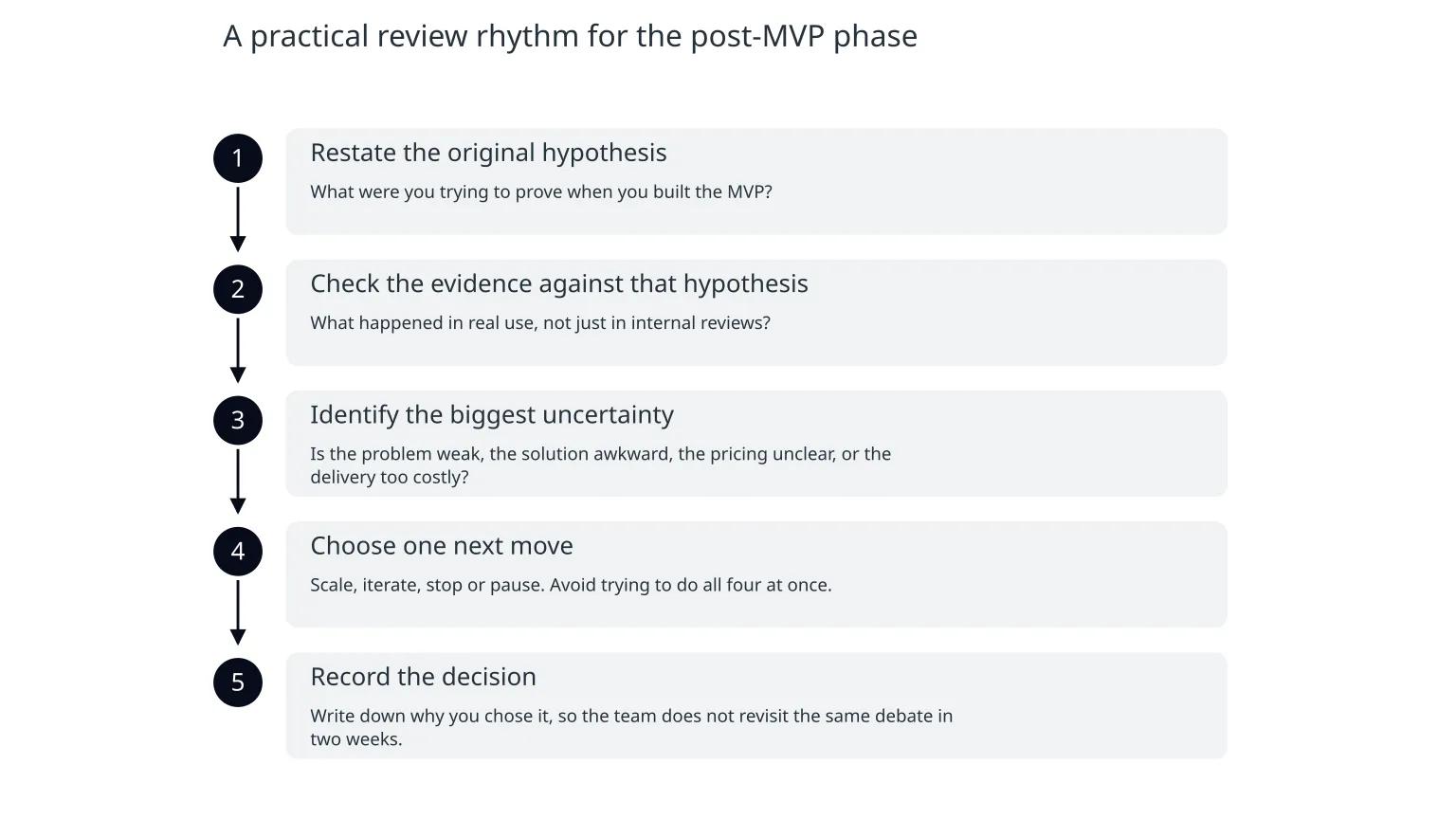
A practical review rhythm for the post-MVP phase
- 1
Restate the original hypothesis
What were you trying to prove when you built the MVP?
- 2
Check the evidence against that hypothesis
What happened in real use, not just in internal reviews?
- 3
Identify the biggest uncertainty
Is the problem weak, the solution awkward, the pricing unclear, or the delivery too costly?
- 4
Choose one next move
Scale, iterate, stop or pause. Avoid trying to do all four at once.
- 5
Record the decision
Write down why you chose it, so the team does not revisit the same debate in two weeks.
That record matters. It creates organisational memory and helps future decisions become less political and more evidence-led. It also makes handover easier if a different team takes over later.
When specialist help is useful
Sometimes the challenge is not the product idea itself. It is that the team cannot see the evidence clearly enough to make a decision. That is where outside help can be useful: defining the right measures, tightening the MVP scope, reviewing technical trade-offs, or working out whether the next stage should be a more robust build, a simpler iteration or a clean stop.
For teams that need to move from a rough MVP into a clearer product plan, a short scoped review can help separate product questions from technical ones. For example, it can reveal whether the next investment should go into better validation, stronger cloud foundations, cleaner data, or a more reliable workflow before more features are added.
That is especially useful where a product has started as a fast experiment but now needs ownership, documentation and a path to something sustainable. The right support should make the decision easier, not push you towards more build for its own sake.

About the author
Nixim Team, Product Engineering
Practical guidance from Nixim on building software, working with AI and running dependable cloud systems.