
What should founders ask before buying an AI tool, SaaS product, or managed service?
A practical founder checklist for buying software, AI tools or managed services with less risk. It focuses on ownership, security, support, handover and what happens if the supplier relationship ends.

On this page
Why it mattersQuestionsOwnershipSecuritySupportExitNext stepsIn short
- Treat supplier choice as a business-risk decision, not just a feature comparison.
- Ask who owns the data, the configuration and the operating knowledge.
- Check support, incident response and access controls before you sign.
- Make exit and handover part of the contract, not a future conversation.
- If the answer is vague, pause before you commit budget or data.
Buying software is the easy part. Owning the outcome is harder.
For founders and business owners, the real question is not only whether a tool looks useful today. It is whether the supplier can support the business safely, whether responsibilities are clear, and what happens if you need to leave later.
That matters for SaaS, AI tools and managed services alike. The shape of the risk changes, but the questions are similar: who controls the data, who responds when things go wrong, what you can export, and how you keep the business running if the relationship ends. UK government guidance on managed services and cloud providers puts clear contracts, access controls, incident handling and exit terms at the centre of that decision.
Why buying a tool is really a risk decision
Start with the business outcome
A new tool should solve a specific problem: save time, reduce manual work, improve service, or make a process reliable enough to scale. But once a product or service touches core work, it also becomes part of your operations. That means the decision is about more than features and price.
Ask what could go wrong
The main risks are usually practical, not dramatic. You may lose access to key data, discover that support is slow, find out the provider relies on a third party you did not know about, or realise no one documented how the system works. Good procurement asks these questions early, before the tool is embedded in daily work.
The questions founders should ask before they buy
0 of 12 complete
Clarify what you own, and what you only rent
You should usually own
Your data, your business rules, your contract terms, your exports, and any custom content or configuration created for your use.
You may only be renting
The software interface, the hosted environment, the model access, the support process, and sometimes the right to use certain features while the contract remains active.
Why this distinction matters
If you cannot separate your business knowledge from the supplier’s platform, you may become stuck. For example, if workflows, prompts or automations live only inside one tool and cannot be exported, switching later becomes slow and expensive. That is true whether the product is a CRM add-on, an AI assistant or a fully managed service.
Illustrative example
Imagine a support team using an AI tool to draft responses. If the tool stores all approved replies in a proprietary format, and no one can extract them cleanly, the team may lose a working knowledge base when the contract ends. The risk is not the AI itself; it is weak ownership and poor portability.
Check the security basics without turning procurement into theatre
- Use least privilege: give the supplier only the access it needs.
- Confirm how 2-step or multi-factor authentication is enforced.
- Ask how incidents are detected, reported and escalated.
- Check whether logs and audit trails are available for important actions.
- Ask what security standards, assessments or references the supplier can point to, if relevant to your risk level.
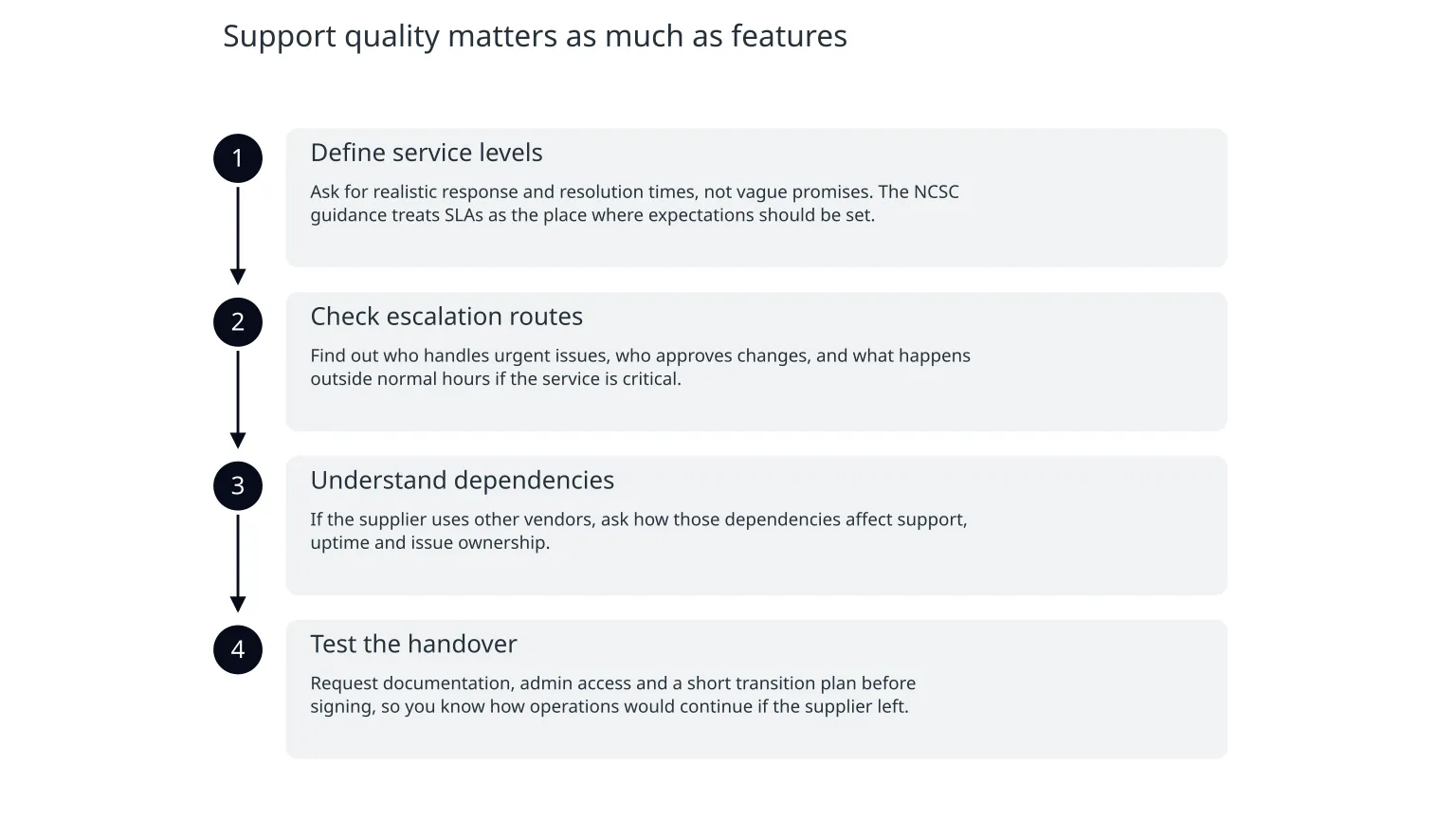
Support quality matters as much as features
- 1
Define service levels
Ask for realistic response and resolution times, not vague promises. The NCSC guidance treats SLAs as the place where expectations should be set.
- 2
Check escalation routes
Find out who handles urgent issues, who approves changes, and what happens outside normal hours if the service is critical.
- 3
Understand dependencies
If the supplier uses other vendors, ask how those dependencies affect support, uptime and issue ownership.
- 4
Test the handover
Request documentation, admin access and a short transition plan before signing, so you know how operations would continue if the supplier left.
Plan for the end at the start
Why exit terms matter
Exit clauses are not a sign of mistrust. They are part of sensible continuity planning. The NCSC specifically includes contract duration and exit terms in its checklist for choosing a managed service provider. That is useful because every supplier relationship ends somehow: by choice, by change, or by failure.
0 of 6 complete
Trade-off to accept
Good exit planning can add a little admin upfront. That is worth it if the tool will sit near core operations, customer data or decision-making. A cheap purchase is not cheap if leaving later becomes a project.
A simple founder process before you buy
- Write down the business problem in one sentence.
- List the data, systems and people the tool will touch.
- Ask the supplier for responsibilities, SLAs, incident handling and exit terms in writing.
- Check that you can export your data and continue operating if the relationship ends.
- Pilot only what you can measure and hand over cleanly.
When specialist help is useful
If the tool will handle customer data, automate important decisions, sit inside your cloud environment or replace an existing process, it is often worth getting a second opinion before you sign. That help is most useful when it improves clarity: what to buy, what to build, what to keep manual, and what to insist on in the contract.
Quiet closing
The best supplier is not just the one with the strongest demo. It is the one you can explain, operate, support and leave without damaging the business. If you can answer those questions now, you are in a much stronger position to buy with confidence.

About the author
Nixim Team, Product Engineering
Practical guidance from Nixim on building software, working with AI and running dependable cloud systems.