
What needs to be proven before you build more, and what evidence should decide whether to scale?
An MVP should prove the riskiest assumption, not list every feature you eventually want. The practical question is simple: what is the smallest test that can give you enough evidence to continue, change direction, or stop?

On this page
StartAssumptionSmallest testThresholdsEvidenceScaleHelpIn short
- An MVP is a learning tool, not the finished product.
- Start with the riskiest assumption, not the easiest feature.
- Choose the smallest test that can produce a clear decision.
- Set stop, continue, or change-direction thresholds before building.
- Use customer behaviour and feedback together; one signal is rarely enough.
The key MVP mistake is building too much before the riskiest assumption has been proven. A good first product is not a smaller version of the final thing. It is a test.
For founders and non-technical business owners, the useful question is not “What features should we include?” It is “What must be true for this idea to deserve more investment?” That shift changes the whole build plan. It helps you spend time on learning, not on making a polished product that still does not answer the real question.
Treat the MVP as a test, not a draft product
An MVP works best when it answers a single business question. That question might be whether customers want the product, whether they will pay for it, whether they can use it without help, or whether the service can be delivered at an acceptable cost. The exact question depends on the business model.
The mistake is to begin with features. Features are only useful when they support a specific test. If you build sign-up flows, dashboards, billing and notifications before proving demand, you may end up with a product that looks complete but still lacks evidence that it should exist.
Find the riskiest assumption first
Every new product carries several assumptions. Some are about demand. Some are about behaviour. Some are about delivery. The riskiest assumption is the one that would make the whole idea fail if it turns out to be wrong.
Demand risk
Do people care enough to try it or pay for it?
Delivery risk
Can you provide the service reliably, safely and at a cost that makes sense?
Usability risk
Can the target user understand and complete the core task without constant support?
Business-model risk
Will the economics work when you include support, operations and future growth?
Pick the highest-risk assumption first. If you are unsure whether a problem is painful enough, test demand before you automate anything. If you know the problem exists but you do not know whether the workflow is practical, test the workflow with a thin prototype or manual process before building software around it.
Choose the lightest test that can still answer the real question
The smallest useful test is the one that can produce a clear signal with the least effort. That might be a landing page, a manual concierge process, a clickable prototype, a short pilot with a few users, or a narrow internal workflow. The right choice depends on what you need to learn.
| Test type | Best for | Main limitation |
|---|---|---|
| Landing page or waitlist | Checking whether the problem and offer attract interest | Shows intent, not actual product use |
| Manual pilot | Learning whether the service works before automating it | Can hide the true cost of delivery |
| Clickable prototype | Testing user flow and comprehension | Does not prove operational delivery |
| Thin MVP | Observing real use with minimal build | Still needs clear success criteria |
| Full build | Only when the core assumptions are already proven | High cost if the premise is wrong |
This is where teams often drift into overbuilding. They add admin panels, reporting, integrations and “nice to haves” because the work feels efficient. But if those additions do not improve the quality of the evidence, they are not reducing risk. They are increasing it.
Set stop, continue, or change-direction thresholds in advance
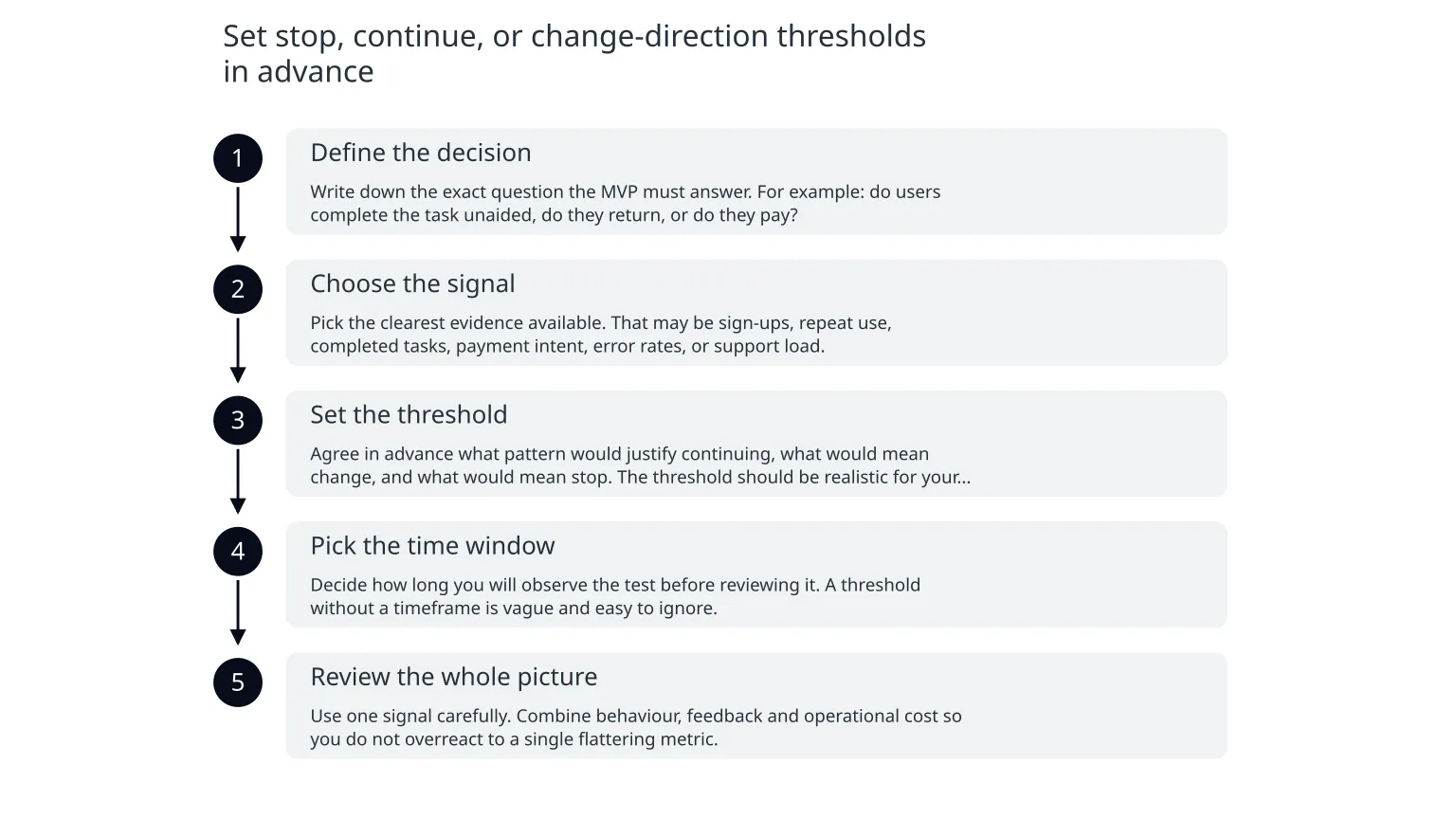
Before you build, decide what evidence will count as enough. Without that line, it becomes easy to keep going because the team has already invested time. Clear thresholds reduce guesswork and help you avoid treating hope as evidence.
- 1
Define the decision
Write down the exact question the MVP must answer. For example: do users complete the task unaided, do they return, or do they pay?
- 2
Choose the signal
Pick the clearest evidence available. That may be sign-ups, repeat use, completed tasks, payment intent, error rates, or support load.
- 3
Set the threshold
Agree in advance what pattern would justify continuing, what would mean change, and what would mean stop. The threshold should be realistic for your market and offer.
- 4
Pick the time window
Decide how long you will observe the test before reviewing it. A threshold without a timeframe is vague and easy to ignore.
- 5
Review the whole picture
Use one signal carefully. Combine behaviour, feedback and operational cost so you do not overreact to a single flattering metric.
What evidence is strong enough to scale?
Strong evidence is not the same as a good reaction from a few people. Positive comments can be encouraging, but they do not always predict repeat use or a workable business model. Likewise, traffic alone does not prove value if users do not complete the core action.
- Real usage of the core workflow, not just clicks or curiosity.
- A pattern of repeat behaviour, not a one-off novelty effect.
- A cost to serve that remains understandable as usage increases.
- Evidence that the offer solves a pain people already recognise.
- A support load that does not collapse the team before the product matures.
If you are testing a B2B product, evidence may come from a small number of serious users who complete the task and want continued access. If you are testing a consumer product, you may need more volume and stronger retention before you can trust the signal. The threshold should fit the market, not a generic template.
When to scale and when to pause
Scale
The core assumption is holding up, users can complete the main task, the economics are sensible, and the next version would improve a proven behaviour.
Pause or change direction
The product is not solving the problem, the evidence is mixed, usage is shallow, support is too heavy, or the team cannot explain why the next build will change the result.
Scaling too early often creates avoidable cost. You may need more infrastructure, more support, more documentation and more maintenance before the underlying value is proven. That is why validated learning matters: it helps you invest after the problem is real, not before.
When an MVP has done its job, the next step is usually not “build everything”. It is to choose the next riskiest assumption and test that. For one team, that might be pricing. For another, it might be onboarding. For another, it might be whether automation can safely replace a manual step.
Where specialist help is useful
A specialist team can help when the decision is not only about product idea, but also about scope, architecture, delivery speed, human review and handover. That is often the case when a founder wants a short, focused build that proves an outcome without leaving the business dependent on a fragile prototype.
For example, a scoped MVP can be helpful when the team needs a clear first release, a working system owned by the business, and a plan for what happens after the test. The value is not in adding more features. It is in reducing ambiguity about what to build, what to measure and what to do next.

About the author
Nixim Team, Product Engineering
Practical guidance from Nixim on building software, working with AI and running dependable cloud systems.