
What should a founder check before buying an AI tool or commissioning a pilot?
A practical founder checklist for AI buying decisions: check accuracy, data handling, ownership, account access, liability and handover before you sign.

On this page
Why it mattersCore checksOwnershipData and securityRun the pilotWhen to slow downIn short
- Check what the AI is allowed to do, and where it must stop and ask.
- Ask where your data goes, who can access it, and what happens on exit.
- Make ownership, liability, admin access and handover part of the first conversation.
- Use a pilot to reduce risk, not to postpone it.
- If a supplier cannot answer these questions clearly, slow down before signing.
AI tools and supplier-led pilots can be useful, but they can also create avoidable problems if you treat them like a feature purchase. A founder is not only buying a model or interface. You are also choosing how data is handled, who is responsible when output is wrong, who controls the account, and whether the system can be handed over cleanly later. Official UK guidance points to the same conclusion: AI procurement needs diligence, not just enthusiasm.
This article is for non-technical founders and business owners who want a simple way to test whether an AI offer is safe, usable and worth the commitment.
Why AI buying is a diligence question
Look beyond the demo
A good demo can still hide weak data controls, unclear liability or a handover problem. The question is not only whether the tool works in a presentation. It is whether it works in your business, with your data, under your responsibility. The ICO advises due diligence before procuring AI systems, datasets or coding, including checking accuracy, bias and design trade-offs, and planning for deletion or return of personal data and support with UK GDPR obligations.
Treat the supplier as part of the risk
If a vendor hosts the model, stores prompts, trains on your content or connects to your systems, they become part of your operational and governance risk. That means you need to ask who owns what, who can change what, and what happens if the relationship ends. Official procurement guidance also highlights AI assurance, procurement transparency and contract clarity as part of the buying process.
The checks to make before you sign
0 of 10 complete
Accuracy is not enough
Founders often ask whether the AI is ‘accurate’. That is important, but incomplete. You also need to know how often it is wrong in the cases that matter to you, whether it fails safely, and whether the system makes it easy to correct or override a bad answer. The Cabinet Office AI Assurance Questionnaire is designed to prompt this kind of lifecycle thinking, including procurement and public transparency questions.
Liability should be explicit
The government Digital, Data and Technology Playbook says AI contracts should consider where liabilities sit if the AI outcome is wrong, especially where data, the algorithm and model training are split across parties. For a founder, that means a contract should not simply say the AI is ‘provided as is’ and leave it there. You need enough clarity to understand who bears the cost and effort of fixing problems.
Ownership and handover are business questions
Know what you can take with you
A pilot can be technically successful and still leave you trapped if the supplier controls the account, the prompts, the data pipeline or the hosting environment. GOV.UK guidance on purchasing strategy says buyers should be explicit about ownership of data and intellectual property, including software code and business rules. That matters because the useful part of many AI builds is not just the model. It is the workflow around it.
A weak setup
The supplier opens all the accounts, stores the data in their own workspace, keeps the logic private and sends you occasional screenshots. If the relationship ends, you may lose visibility and control.
A stronger setup
You own the core accounts, know where the data lives, can export prompts and outputs, have access to logs and documentation, and can hand the system to another team without starting over.
Admin access should not be an afterthought
The NCSC advises organisations to protect admin accounts with 2-step verification, keep recovery information current, use separate admin and normal user accounts, and know how to recover access if an admin account is lost or compromised. That advice applies directly to AI tools that can send messages, change data or trigger workflows. If the supplier controls the only admin login, you do not really control the system.
Check data handling before you connect anything
Start with the smallest useful data set
Do not give a new AI tool full access to your records just because it can connect easily. Start with the minimum data needed for the pilot, and be clear about whether that data includes personal data, confidential material or payment-related information. The ICO specifically recommends considering deletion and return clauses, and support for UK GDPR security and breach obligations, when procuring AI-related services.
- Ask where data is stored and which vendors can access it.
- Check whether logs include personal or sensitive information.
- Confirm retention periods for prompts, outputs and uploaded files.
- Make sure there is a process for deletion or export at the end of the pilot.
- Review whether human approval is needed before any external action is taken.
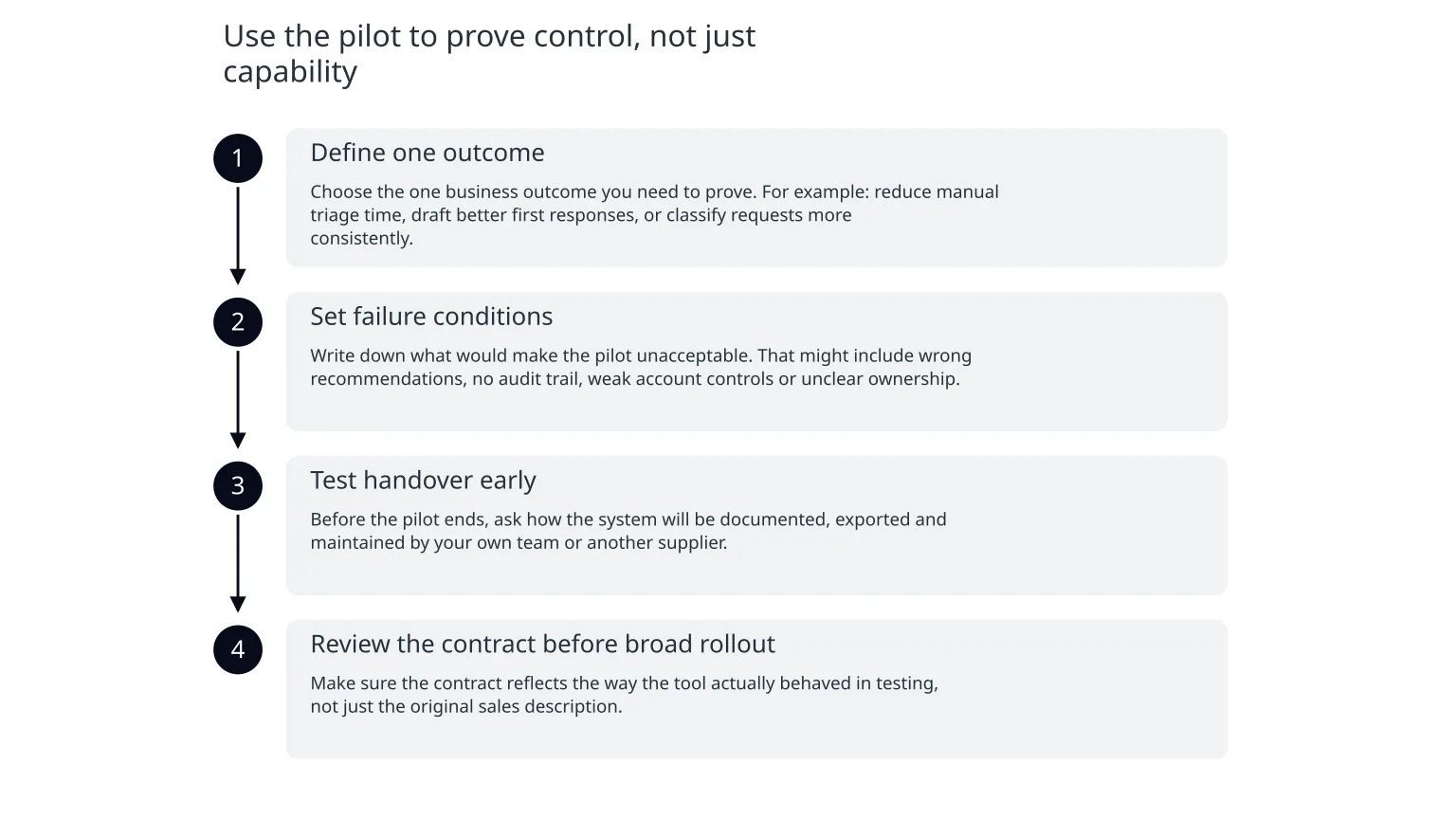
Use the pilot to prove control, not just capability
- 1
Define one outcome
Choose the one business outcome you need to prove. For example: reduce manual triage time, draft better first responses, or classify requests more consistently.
- 2
Set failure conditions
Write down what would make the pilot unacceptable. That might include wrong recommendations, no audit trail, weak account controls or unclear ownership.
- 3
Test handover early
Before the pilot ends, ask how the system will be documented, exported and maintained by your own team or another supplier.
- 4
Review the contract before broad rollout
Make sure the contract reflects the way the tool actually behaved in testing, not just the original sales description.
Signs you should pause or narrow scope
0 of 7 complete
These are not deal-breakers every time
Some issues can be fixed by narrowing the pilot, changing the architecture or adding guardrails. But if the answers remain vague, the safest move is to slow down. That is not caution for its own sake. It is basic commercial discipline.

About the author
Nixim Team, Product Engineering
Practical guidance from Nixim on building software, working with AI and running dependable cloud systems.