
What should a serverless project standardise early so it stays easy to own and extend later?
A practical guide to the early standards that make a serverless system easier to operate after the first release: tags, naming, deployment checks, version control and clear ownership.

On this page
Why it mattersTagsOwnershipDeploymentsVersioningWhen to get helpIn short
- Standardise tags, naming and ownership before the system grows.
- Use deployment checks and rollback paths, not hope, to manage release risk.
- Keep versioning, release notes and infrastructure definitions in source control.
- Treat serverless as an operating model, not just a deployment style.
Serverless systems often feel simple at the start. You define a few functions, wire up an API, deploy, and move on. The trouble usually appears later, when a second person needs to change the system, a release goes wrong, or no one can tell who owns which resource. AWS’s SAM documentation history is a reminder that the platform evolves, so your internal standards need to be more stable than any single framework version.
The aim is not heavy process. It is to make the first build easier to understand, safer to change and cheaper to recover if something breaks.
Why serverless needs standards early
Serverless can reduce infrastructure work, but it does not remove the need for good operating discipline. In practice, the earlier you standardise, the less time you spend later guessing which function belongs to which feature, which environment a resource supports, or whether a deployment is safe to repeat. AWS SAM is a living framework, and its documentation history shows ongoing change over time. That makes internal consistency more important, not less.
Standardise tags before costs and ownership get fuzzy
Tags are not just for cost allocation. AWS recommends a formal tagging schema: decide mandatory keys, define allowed values, agree naming conventions and decide who can create new tag keys. It also notes that tags are metadata, not a place for sensitive data such as PII, and that support for tags varies by service and resource type.
Useful tag examples
Illustrative examples only: application, environment, owner, cost-centre, data-classification, and lifecycle stage.
What tags help with
Ownership, environment separation, chargeback or showback, auditability and faster troubleshooting when resources are shared.
The practical benefit is simple: when a function, queue or bucket has the same core tags everywhere, you can search, group and review resources without relying on tribal knowledge. The trade-off is slight setup overhead at the start. That overhead is usually worth it, especially when multiple people or environments are involved.
Make resource ownership obvious
Ownership gets messy when a serverless project mixes feature code, deployment code and shared cloud resources without clear boundaries. A better pattern is to define who owns the function, who owns the infrastructure template, and who is responsible for the runtime behaviour after release. That way, operational questions have a default answer.
| Area | Standard to set | Why it helps |
|---|---|---|
| Resource tags | Mandatory keys and allowed values | Makes ownership and environment visible |
| Repository structure | Separate application logic from infrastructure definitions | Reduces accidental changes and review confusion |
| Change approval | Who can merge and deploy to production | Prevents untracked releases |
| Runbook links | Where to find rollback and alert steps | Speeds up recovery when something fails |
Treat deployment hygiene as part of the design
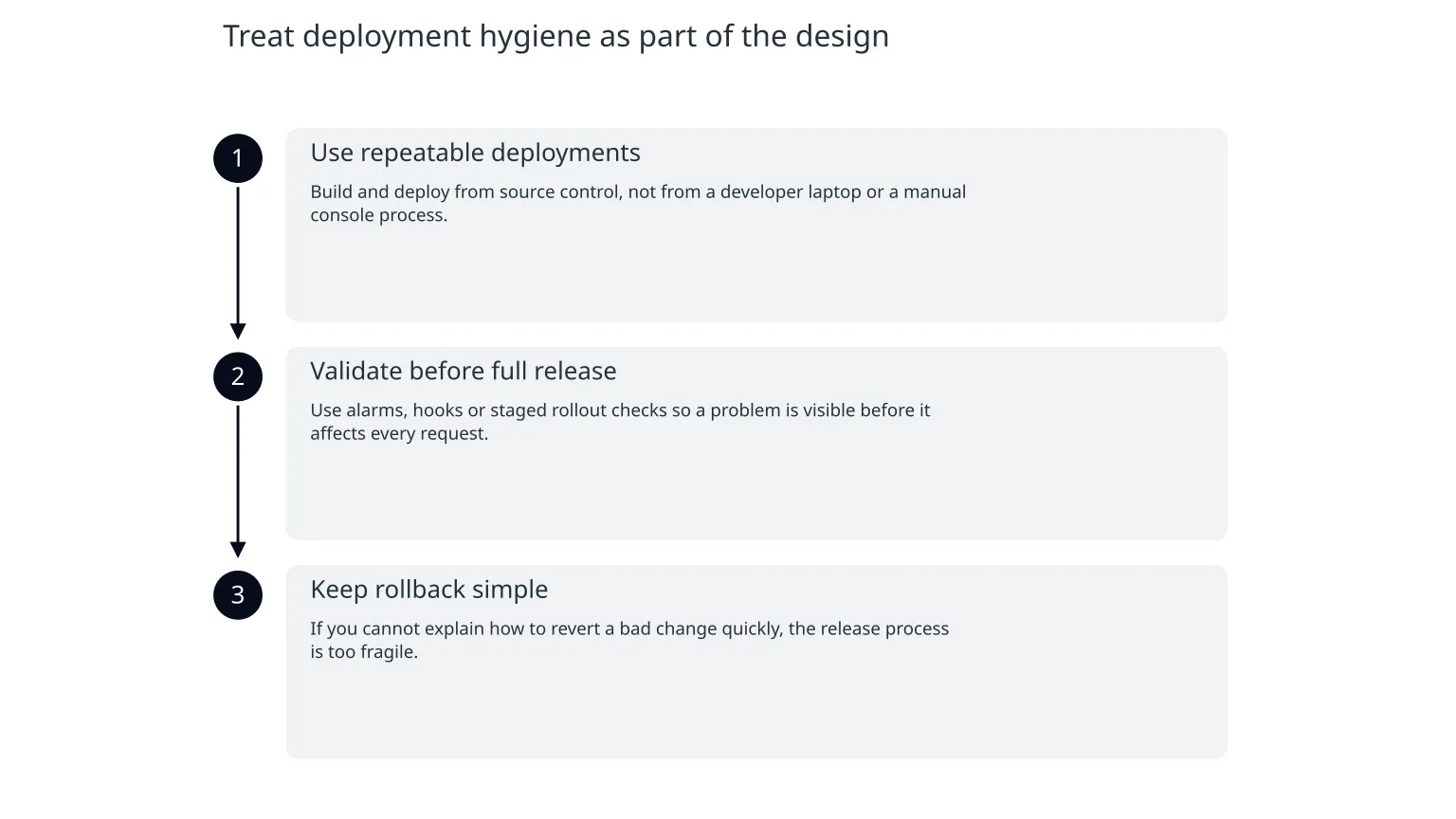
AWS’s Serverless Applications Lens recommends deployment validation and rollback support, including CodeDeploy hooks and alarms, rather than assuming a deployment will work first time. It also recommends orchestration with state machines instead of tightly chaining Lambda functions together in code when the workflow needs coordination.
- 1
Use repeatable deployments
Build and deploy from source control, not from a developer laptop or a manual console process.
- 2
Validate before full release
Use alarms, hooks or staged rollout checks so a problem is visible before it affects every request.
- 3
Keep rollback simple
If you cannot explain how to revert a bad change quickly, the release process is too fragile.
Put release history under source control
Release discipline matters because serverless systems change in small pieces, often more frequently than a traditional monolith. AWS Prescriptive Guidance for CloudFormation version control recommends semantic versioning, consistent version tags, documenting release impacts and keeping version mappings under source control. That guidance is useful even if your stack is not built entirely on CloudFormation.
0 of 5 complete
The benefit of versioning is not just traceability. It also makes handover possible. If a future team takes over, versioned templates and release notes reduce the chance that they have to reverse-engineer the system from production behaviour.
When specialist help is useful
A small team can define these standards itself if the system is modest and the deployment path is simple. Specialist help becomes more useful when the project has multiple environments, several teams touching the same stack, security or privacy concerns, or a history of releases that are hard to repeat safely. In those cases, an outside review can help turn vague habits into a clear operating model.
Nixim’s cloud architecture and migration work is relevant where a team needs practical help turning those standards into a maintainable AWS setup, but the core decision is the same either way: make the system understandable before it becomes hard to change.

About the author
Nixim Team, Product Engineering
Practical guidance from Nixim on building software, working with AI and running dependable cloud systems.