
What stays with the director when you hire help to run the business?
Hiring an accountant, agency or contractor can remove workload, but it does not remove a director’s core responsibility. This checklist explains what can be delegated, what should stay under director control, and what to put in writing so accountability and handover stay clear.

On this page
StartDelegateKeepIn writingCheckRisksHelpNext stepsIn short
- Delegating work does not delegate legal responsibility.
- Directors still need to oversee records, filings, judgement and conduct.
- The safest handover is one where roles, deadlines and approval steps are written down.
- Specialist help is useful when the work is time-sensitive, regulated, technical or easy to misread.
- Good handover reduces confusion, not accountability.
Hiring help can make a company easier to run, but it does not move legal responsibility away from the director. GOV.UK is clear that a director remains responsible for the company’s records, filings, judgement and conduct, even when an accountant, agency or other professional handles day-to-day tasks.
For founders, the practical question is not “Can I delegate this?” It is “What can I delegate safely, what must I still check, and what should be agreed in writing so nothing important is left to assumption?”
This checklist is written for non-technical founders and business owners who want a simple way to keep control while using outside help well.
Start with the rule that does not change
The core rule is simple: a director can get help, but the director still remains legally responsible for running the company. GOV.UK says you can hire professionals to help with administration and day-to-day tasks, but you are still responsible for the company’s records, accounts, filings and overall performance.
That is why outsourcing works best when the founder stays clear about ownership. If someone else is filing, drafting, bookkeeping, updating systems or coordinating work, you still need to know what they are doing, when it is due, what evidence supports it, and where you would step in if something looks wrong.
What you can usually delegate
Many routine tasks can be handed over to a professional or contractor. The point is to reduce drag, not to detach yourself from the business. GOV.UK specifically notes that directors can delegate administration, but not their legal responsibility.
- Bookkeeping and day-to-day record keeping, if someone else is maintaining them properly.
- Preparing draft filings, management reports or meeting packs for you to review.
- Operational tasks such as scheduling, customer support admin or project coordination.
- Agency work such as design, marketing delivery, development or content production.
- Specialist advice where you still make the final decision after reviewing the options.
Illustrative example: a founder might ask an accountant to prepare the numbers, but still review whether the records are complete, whether a filing deadline is coming up, and whether anything unusual needs attention before submission. The accountant helps with the work; the director remains responsible for ensuring it is right.
What should stay with the director
Some responsibilities should never be treated as someone else’s job simply because another person is helping. The director must still use independent judgement, exercise reasonable care, skill and diligence, avoid conflicts of interest and not misuse company property or confidential information.
0 of 6 complete
What to agree in writing before someone starts
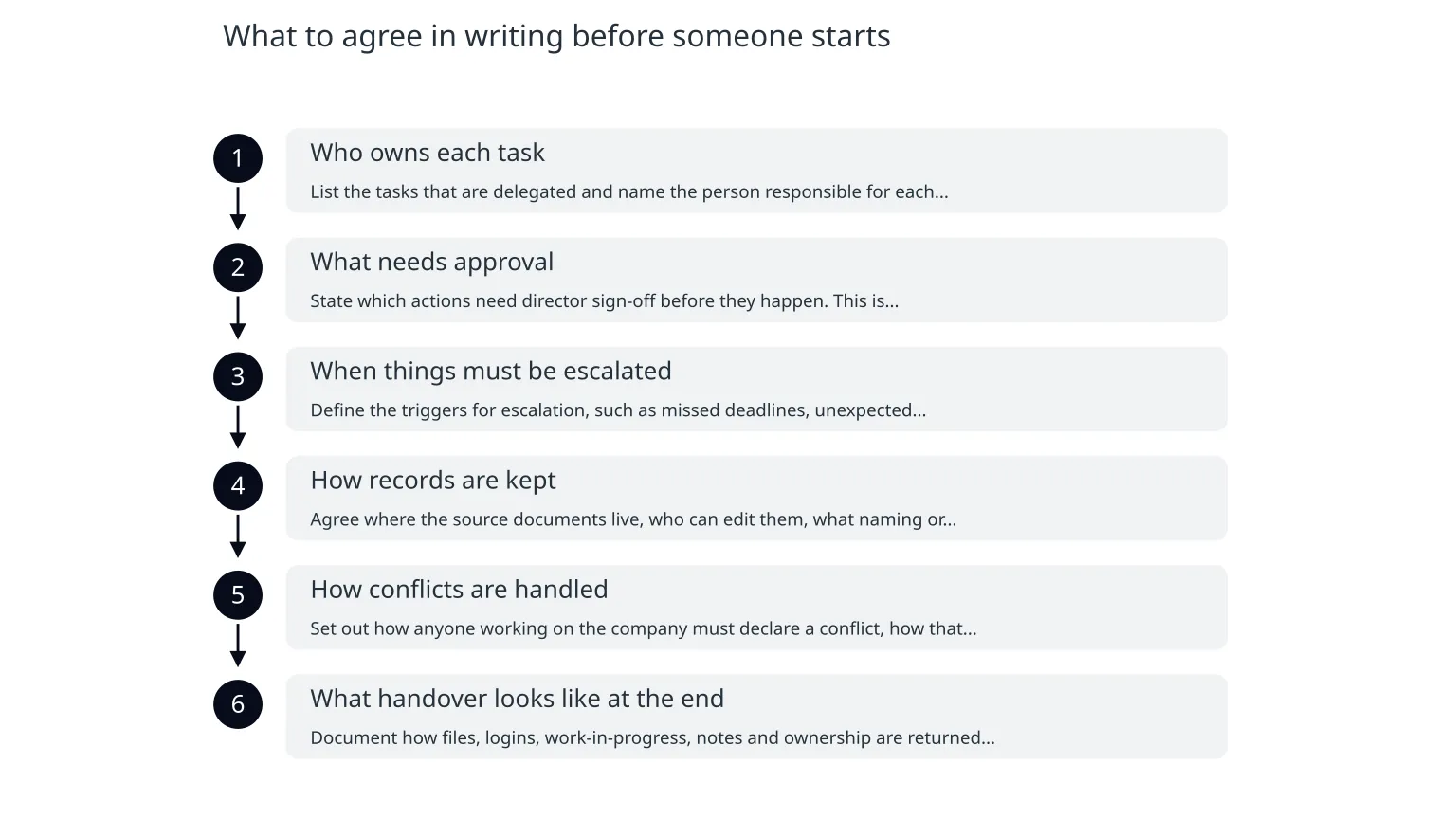
The best handover is explicit. If you want someone else to help run part of the business, spell out what they do, what they do not do, when they escalate issues, and who signs off each step. This reduces confusion later and makes it easier to prove what was agreed if the relationship changes.
- 1
Who owns each task
List the tasks that are delegated and name the person responsible for each one. Be clear about whether they prepare, review, file, submit or only advise.
- 2
What needs approval
State which actions need director sign-off before they happen. This is especially important for filings, payments, contracts, access changes and anything that affects control of the company.
- 3
When things must be escalated
Define the triggers for escalation, such as missed deadlines, unexpected costs, unusual transactions, errors in records, security issues or a change in business circumstances.
- 4
How records are kept
Agree where the source documents live, who can edit them, what naming or version rules apply, and how long records will be retained.
- 5
How conflicts are handled
Set out how anyone working on the company must declare a conflict, how that conflict is reviewed and what happens if it affects a decision.
- 6
What handover looks like at the end
Document how files, logins, work-in-progress, notes and ownership are returned if the contractor, agency or adviser leaves.
A quick founder check before you hand over work
| Question | If the answer is unclear | What to do |
|---|---|---|
| Who is responsible for this task? | People may assume someone else is watching it. | Name one owner and one approver. |
| What deadline matters? | Deadlines can slip without anyone noticing. | Write the date, reminder point and fallback plan. |
| Where is the evidence? | No one can prove what was filed, approved or changed. | Keep a shared record of documents, decisions and messages. |
| Who can make changes? | Access can be wider than intended. | Review permissions and remove unnecessary access. |
| What happens if the supplier leaves? | Handover can become chaotic. | Agree exit steps, file transfer and account ownership in advance. |
If the answer to any of these questions is fuzzy, the arrangement is not ready enough. That does not mean you should not delegate. It means the handover needs a little more structure before important work starts.
Where founders often go wrong
Helpful delegation
A contractor or adviser does the work, but the founder understands the scope, reviews the output and keeps the final decision.
Risky delegation
The founder assumes “they’re handling it” and stops checking deadlines, evidence, access and approvals.
- Confusing support with ownership. A supplier can manage a process without carrying the director’s responsibility for it.
- Letting the business run on memory. If only one person knows the process, handover will be fragile.
- Assuming tools are controls. Software can help, but it does not replace judgement or review.
- Ignoring changes in risk. A simple task may become more sensitive as the business grows, takes payments or handles more data.
- Failing to document exceptions. If something unusual happens, write down what was decided and why.
A common mistake is to treat a supplier relationship like a clean transfer of responsibility. It is not. The useful mental model is shared work, retained accountability.
When specialist help is useful
Specialist help is most useful when the work is technical, time-sensitive, repetitive or easy to get wrong. That can include bookkeeping, compliance support, legal drafting, software delivery, cloud setup, or any process where the company needs speed but still wants control.
For founders, this kind of support is valuable when it comes with clear handover: written scope, visible work-in-progress, plain-language explanations, and a final owner inside the business who can take over if needed. That is especially important when outside help is shaping software, automating processes or handling data, because the founder still needs to understand what is being built and what risk it creates.
A simple next-step checklist for founders
0 of 6 complete
The practical goal is not to keep everything personal. It is to stay informed enough that you can lead the company properly while using outside help well. That balance protects the business and makes handover safer for everyone involved.

About the author
Nixim Team, Product Engineering
Practical guidance from Nixim on building software, working with AI and running dependable cloud systems.