
When clicks and leads stop being enough: moving from reporting to incrementality testing
Basic tracking can tell you what happened. Incrementality testing helps you see whether a channel actually caused growth. This article explains the point where simple reporting stops being enough, and how to move toward stronger evidence without overcomplicating measurement.

On this page
The decisionWhat changesWhen to upgradeA practical pathTrade-offsSafeguardsNext stepIn short
- Basic conversion tracking is good for day-to-day optimisation, but it does not prove causality.
- Incrementality testing compares exposed and unexposed groups to estimate true impact.
- Use simple reporting first; move to experiments when budget decisions depend on real lift, not just attributed results.
- The main trade-off is rigour versus speed: stronger evidence takes planning, coordination and cleaner test design.
- A practical path is to start with clean tracking, then add holdout or geo tests when the channel is large enough to matter.
If you only track clicks and leads, you may know what happened, but not whether marketing actually caused growth. That is fine at the start. It is not enough once spending decisions become meaningful, channels overlap, or a team starts arguing about which campaigns deserve more budget. At that point, the question changes from “what converted?” to “what would have happened anyway?”
That is where incrementality testing becomes useful. It does not replace reporting. It sits above it and answers a harder question: did this channel add customers, or did it mostly capture people who would have converted elsewhere?
Basic reporting is useful until the decision gets bigger
Most growing teams begin with the same tools: conversion tracking, platform dashboards and a simple view of leads or sales by channel. That is sensible. It helps you see trends, spot obvious waste and compare campaigns over time.
The problem is that attributed conversions are not the same as causal impact. A lead may be recorded against a paid channel, but the customer might have already known your brand, searched later, or converted anyway after another touchpoint. Google’s measurement guidance says effective ROI measurement usually combines several methods, including first-party data, media mix modelling, incrementality testing and data-driven attribution.
So the real decision point is not whether reporting is “bad”. It is whether the business has moved beyond using reporting as a steering wheel and now needs evidence strong enough to guide budget, channel mix or hiring decisions.
What incrementality testing adds
Incrementality testing asks a different question from attribution. Instead of asking “which channel got credit?”, it asks “what extra outcome did the channel create?” Google defines incrementality testing as a randomised controlled experiment with exposed and unexposed groups, designed to measure causal impact rather than simply observed conversions.
That makes it more rigorous than a dashboard, but also more demanding. You need a test design, a control group, a defined outcome and enough time for the experiment to run without being distorted by unrelated campaigns or promotions.
Basic reporting
Shows clicks, leads, cost per lead, attributed revenue or similar metrics. Good for monitoring and routine optimisation, but it can overstate the effect of a channel.
Incrementality testing
Estimates the lift caused by a channel by comparing exposed and unexposed groups. Better for budget decisions and channel validation, but slower and more demanding to run properly.
Signs that reporting is no longer enough
- You are spending enough that a wrong decision would matter.
- More than one channel influences the same customer journey.
- You are scaling spend, not just testing a single campaign.
- Leaders are asking whether a channel is truly adding customers or just taking credit.
- The dashboard looks healthy, but the business result is not improving in the same way.
- You need to decide whether to keep, cut or expand a channel.
These are the points where attribution starts to lose decision value. If the channel is cheap, simple and isolated, reporting can still be enough. If the channel is central to growth, or if you are debating spend across teams, then better measurement is worth the effort.
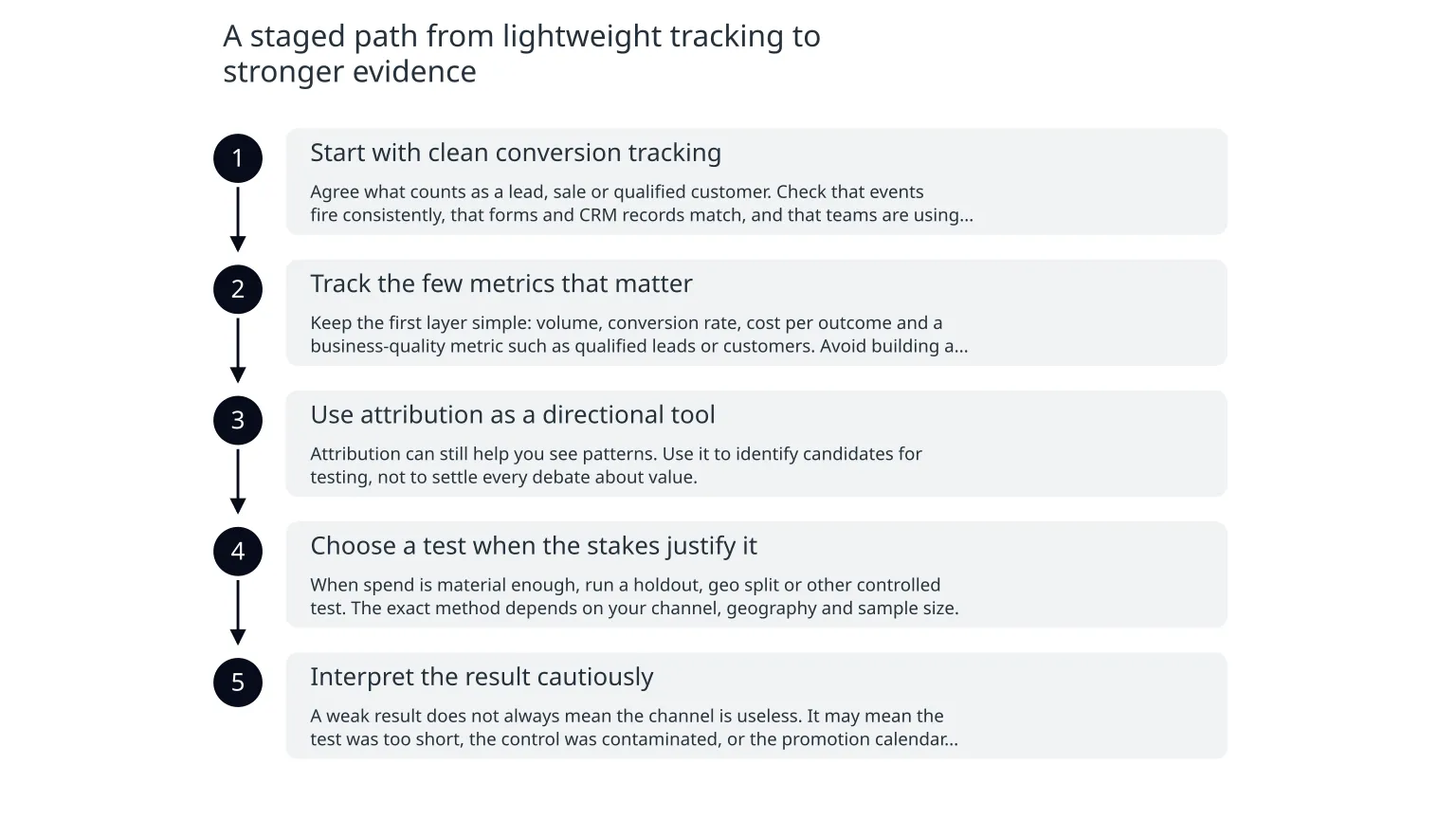
A staged path from lightweight tracking to stronger evidence
- 1
Start with clean conversion tracking
Agree what counts as a lead, sale or qualified customer. Check that events fire consistently, that forms and CRM records match, and that teams are using the same definitions.
- 2
Track the few metrics that matter
Keep the first layer simple: volume, conversion rate, cost per outcome and a business-quality metric such as qualified leads or customers. Avoid building a measurement stack that is harder to maintain than the channel itself.
- 3
Use attribution as a directional tool
Attribution can still help you see patterns. Use it to identify candidates for testing, not to settle every debate about value.
- 4
Choose a test when the stakes justify it
When spend is material enough, run a holdout, geo split or other controlled test. The exact method depends on your channel, geography and sample size.
- 5
Interpret the result cautiously
A weak result does not always mean the channel is useless. It may mean the test was too short, the control was contaminated, or the promotion calendar was too noisy.
What you gain, and what you give up
What you gain
Better evidence for budget allocation Less dependence on vanity metrics Clearer answers when channels overlap A stronger basis for planning growth
What you give up
Speed of decision-making Simplicity Low setup effort Some flexibility in campaign timing
That trade-off matters. Incrementality testing can be the right answer, but it is not the cheapest answer in time or coordination. Google’s guidance notes that tests need careful planning around media budgets and promotions, and IAB guidance similarly stresses credible counterfactuals, assumptions and test limitations.
In practice, that means the business should not rush into experiments just because they sound more advanced. A clean dashboard that supports confident day-to-day decisions can be more useful than a poorly designed test that produces false certainty.
How to avoid misleading results
0 of 7 complete
What a sensible next move looks like
For most founders and marketing leads, the right next step is not a full measurement overhaul. It is a small review of how decisions are currently made. Ask: what are we trusting today, what decisions depend on it, and where is the risk of being wrong highest?
If the answer is “our dashboard is fine for now”, keep it simple. If the answer is “we are about to spend more, hire more or shift budget materially”, then it may be time to add a proper experiment design to the measurement mix. GOV.UK’s discussion of high-growth firms underlines that scaling businesses face sharper finance and resource decisions, which makes better evidence more valuable.
For teams that need help with tracking, dashboards or a first experiment design, specialist support can be useful — especially when the data is fragmented or the measurement question has become too important to answer by instinct alone. The goal is not perfection. It is a better decision with the evidence available.

About the author
Nixim Team, Product Engineering
Practical guidance from Nixim on building software, working with AI and running dependable cloud systems.