
When serverless starts to feel hard to own, what should you review first?
A practical guide to checking whether a serverless system is still easy to run, support and hand over. It uses the AWS Well-Architected lens to look at operational excellence, reliability and cost before hidden overhead grows into avoidable work.

On this page
Why it driftsFirst reviewReliabilityCostHandoverWhat to do nextIn short
- Serverless reduces some infrastructure work, but it does not remove operational responsibility.
- Review ownership, monitoring, retries, idempotency and cost controls before problems spread.
- If a new developer could not explain the system quickly, the handover is probably too fragile.
- The right review is practical: where do failures land, who is alerted, and what does each event cost?
- A short Well-Architected check can reveal whether serverless is still helping or quietly adding overhead.
Serverless often looks low-maintenance at the start. You do not manage servers, patch operating systems or size fleets in the usual way. But live systems still need logging, alerts, failure handling, cost checks and clear ownership. If those pieces are weak, serverless can become difficult to support even when the underlying platform is working as designed.
AWS’s Well-Architected guidance is useful here because it treats operational excellence, reliability and cost as active design concerns rather than one-time setup tasks. The question is not whether serverless is “good” or “bad”. It is whether your current setup is still easy to operate, support and hand over.
Why serverless can stop feeling simple
Serverless usually starts with a promise of less administration. That part can be true. You spend less time on server management and more time on product work. But once the system is live, the work changes rather than disappears. You still need to know when something fails, how quickly it fails, where the logs live, who owns the next action and what happens when events arrive more than once.
AWS’s serverless guidance makes this distinction clear. The Well-Architected Framework is not just about how the code runs; it is also about how the workload is prepared, operated and improved over time. That means a serverless setup can be technically correct and still be hard to own if alerts are noisy, recovery steps are unclear, or cost is left to surprise you later.
Start with ownership and visibility
The first question is not about tools. It is about ownership. Can your team clearly explain who looks after the system, which alerts matter, and what a normal day of support looks like? If the answer is vague, start there before changing more code.
AWS’s operational excellence guidance for serverless emphasises metrics and alerts, centralised logging, distributed tracing, testing and deployment discipline. In practice, that means you should be able to answer a few basic questions quickly: what changed, what failed, how far did it spread and what should happen next?
- Are logs easy to find, and are they grouped by environment and service?
- Do you have alerts for user-impacting failures rather than only infrastructure noise?
- Can someone trace a request or event across the system without guessing?
- Is there a named owner for each important function, queue, workflow or integration?
- Would a new engineer understand the support path within a short handover session?
Check failure handling before you trust scale
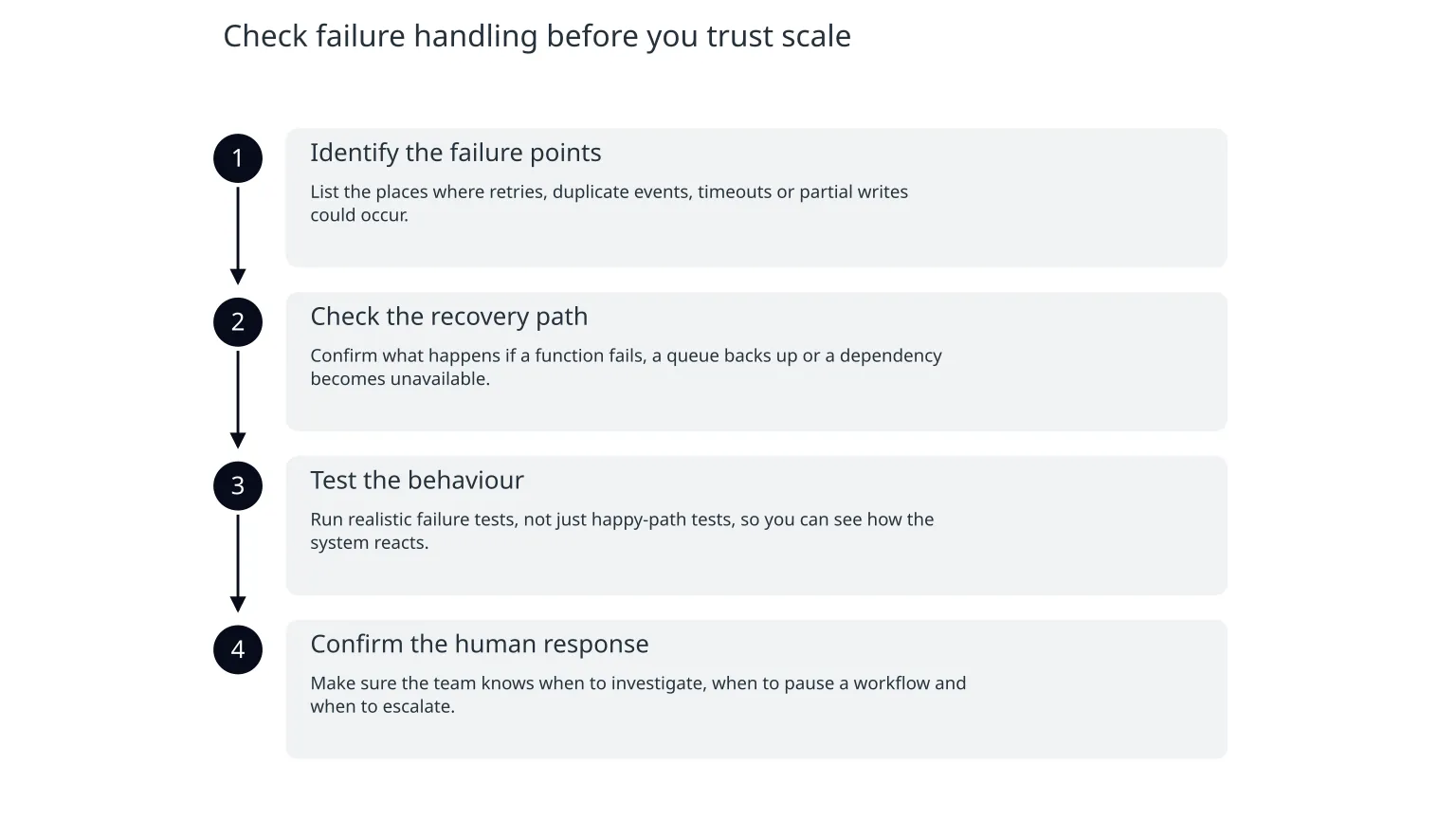
Reliability in serverless systems depends on more than automatic scaling. AWS says you need a planned foundation and monitoring, plus mechanisms that handle demand changes, misconfiguration and transient network issues. In other words, the platform can absorb load, but your application still has to behave well when something goes wrong.
A common weak point is assuming each event is processed once and only once. AWS explicitly warns that serverless events can be delivered more than once, so downstream calls should be designed for retries and idempotency. If a duplicate event could create a duplicate invoice, a duplicate email or two conflicting updates, the system is not yet safe enough to treat as low-maintenance.
- 1
Identify the failure points
List the places where retries, duplicate events, timeouts or partial writes could occur.
- 2
Check the recovery path
Confirm what happens if a function fails, a queue backs up or a dependency becomes unavailable.
- 3
Test the behaviour
Run realistic failure tests, not just happy-path tests, so you can see how the system reacts.
- 4
Confirm the human response
Make sure the team knows when to investigate, when to pause a workflow and when to escalate.
Review cost as usage grows
Serverless can be cost-effective because some services, such as Lambda, do not cost anything while idle. But that does not make the whole setup cheap by default. AWS notes that trade-offs still matter and that poorly benchmarked or over-provisioned designs can waste money.
The practical risk is not usually one giant bill. It is small, repeated waste: chatty functions, unnecessary invocations, over-long retries, duplicated work, excessive logging, unbounded event growth or services left running when they are no longer needed. These issues are easy to miss because each one looks minor in isolation.
Healthy pattern
The team knows what each request, event or workflow roughly costs, tracks the main cost drivers and reviews them when usage changes.
Risky pattern
Nobody is sure which parts of the system create cost, so billing is only reviewed after the invoice arrives.
| Area | What to check | Why it matters |
|---|---|---|
| Invocation patterns | Are functions being triggered more often than expected? | Unexpected volume can hide in retries, loops or noisy integrations. |
| Retry behaviour | Do retries stop after a sensible limit? | Unlimited retry chains can create both cost and support problems. |
| Logs and traces | Are you storing more than you need? | Observability is useful, but it still has a price. |
| Idle resources | Are supporting services switched off when unused? | Serverless removes some idle cost, but not all surrounding cost. |
| Benchmarking | Do you know the cost of a typical workflow? | Without a baseline, it is hard to tell whether spend is healthy or drifting. |
Can someone else safely take over?
A serverless system is only easy to own if it is easy to hand over. That means documentation should explain the shape of the system, the meaning of its alerts, the main failure modes and the steps for common incidents. If knowledge lives only in the original builder’s head, the setup is fragile even if it is technically modern.
This is where operational excellence and reliability meet day-to-day business continuity. A good handover does not just list components. It explains how the parts fit together, where the boundaries are and which decisions need a person. AWS’s guidance supports that mindset by treating preparation, operation and evolution as part of the design itself.
Document the normal path
Explain how data enters, moves through and leaves the system.Document the exception path
Show what happens when a retry fails, a dependency times out or a queue grows.Document the ownership path
Name who gets alerted, who investigates and who approves changes.Document the recovery path
Record how to restore service, roll back changes or drain work safely.A practical next step if your setup feels fragile
0 of 6 complete
If the review shows only small gaps, you may be able to tighten monitoring, retries and documentation without rebuilding the system. If the gaps are structural, it may be worth redesigning parts of the workflow so operational work is visible rather than hidden. That is often the difference between a serverless setup that feels simple and one that quietly becomes expensive to support.
For teams that want help with AWS architecture, migrations or cost guardrails, specialist support is most useful when the issue is not just code quality but ownership across logging, reliability, retries and handover. The goal is not to make serverless look difficult. It is to make sure it stays as easy to run as the original promise suggested.

About the author
Nixim Team, Product Engineering
Practical guidance from Nixim on building software, working with AI and running dependable cloud systems.