
When should you use a smaller AI model, and when should you escalate?
A practical routing rule for teams using AI assistants or workflow automation: use smaller models for routine, low-risk work, and escalate to stronger models when the task is uncertain, consequential or expensive to get wrong. The point is not model prestige; it is matching capability, cost and risk to the job.

On this page
RuleEscalateDesignRiskSetupIn short
- Use smaller models for high-volume, low-risk tasks such as summarising, classifying and extracting straightforward information.
- Escalate when the output could affect money, customers, operations or compliance, or when the model shows uncertainty.
- Build a fallback path because vendor model availability changes over time.
- Routing by task, not brand, is usually the simplest way to manage AI cost and quality.
Many teams overpay for simple AI tasks because every prompt goes to the biggest model by default. That can make sense for critical reasoning, but it is a blunt way to run everyday automation. A better approach is to route work by risk, complexity and cost. Small models can handle many repetitive tasks well, while larger models are better reserved for cases where accuracy, context or judgement matter more. The useful question is not “which model is best?” but “which model is enough for this request, and when should we hand off?”
Start with the task, not the model
A useful default
For many business workflows, a smaller model is enough for the first pass. That is especially true when the job is repetitive, the expected answer is fairly structured, and a mistake can be caught before action is taken. Examples include classifying a support ticket, summarising a long thread, drafting a routine reply, or extracting fields from familiar documents. Anthropic positions Claude Haiku 5.5 as a fast small model for high-volume, cost-sensitive work such as summaries, classification and database queries.
Why this matters
If every request goes to the most capable model, you often pay for reasoning you do not need. That can be wasteful on high-volume tasks, and it can also make teams more cautious about using AI at all. Routing creates a better balance: low-risk work takes the faster path, and only the harder cases consume more compute.
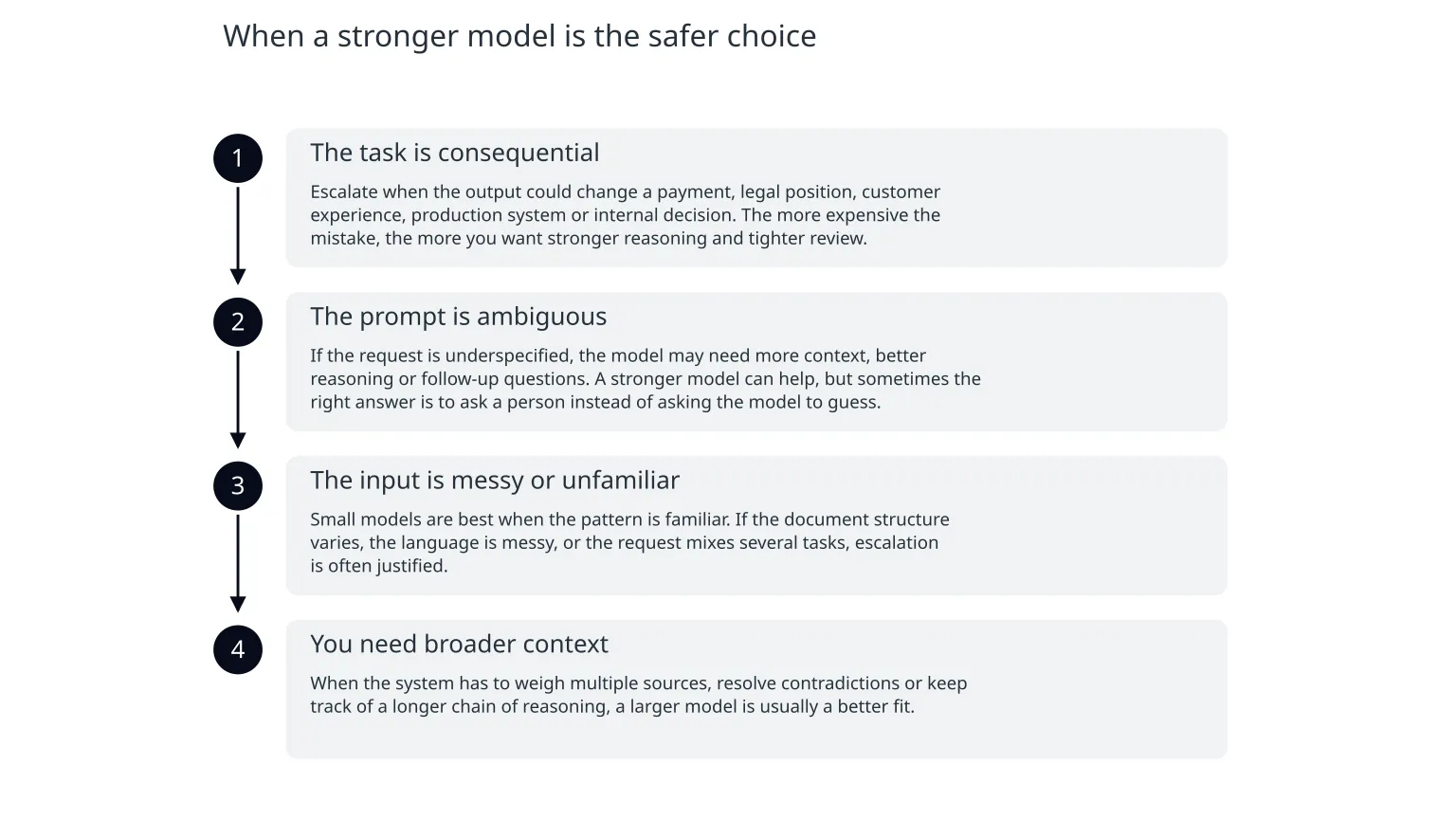
When a stronger model is the safer choice
- 1
The task is consequential
Escalate when the output could change a payment, legal position, customer experience, production system or internal decision. The more expensive the mistake, the more you want stronger reasoning and tighter review.
- 2
The prompt is ambiguous
If the request is underspecified, the model may need more context, better reasoning or follow-up questions. A stronger model can help, but sometimes the right answer is to ask a person instead of asking the model to guess.
- 3
The input is messy or unfamiliar
Small models are best when the pattern is familiar. If the document structure varies, the language is messy, or the request mixes several tasks, escalation is often justified.
- 4
You need broader context
When the system has to weigh multiple sources, resolve contradictions or keep track of a longer chain of reasoning, a larger model is usually a better fit.
A simple safety line
A useful operating rule is to treat escalation as the default whenever an AI output will be used without another check and the impact is material. That is consistent with Nixim’s broader guidance on human-in-the-loop design: AI should stop and ask a person when the consequences are meaningful or the confidence is low.
A practical routing pattern
Fast path
Use a smaller model for routine, repetitive and low-risk requests. Keep the output narrow, structured and easy to validate.
Escalation path
Send uncertain, messy or high-impact requests to a stronger model, or to a person if the model still cannot reach a dependable answer.
Illustrative example
Imagine a support team using AI to help with incoming queries. The first model can sort tickets into categories, draft short replies and pull known policy snippets. If the request involves a refund dispute, account access problem or unusual edge case, the system escalates to a stronger model or a human reviewer before anything is sent. The value is not just lower cost; it is fewer risky decisions made by default.
What to measure
Do not measure only how many requests were handled automatically. Track whether the routing rule sends the right cases down the right path. Useful signals include correction rate, escalation frequency, repeat-review volume, and the amount of manual rework after the AI draft.
Trade-offs, failures and misuse
Smaller is not always cheaper in practice
A cheaper model can become expensive if it produces too many errors, because every error creates review time, customer friction or rework. The cheapest request is the one that is answered correctly enough the first time.
Bigger is not always better
Larger models can improve quality, but they can also encourage over-trust. Teams may stop checking outputs simply because the model sounds fluent. That is dangerous in workflows where the answer drives action.
The operational risk
If your workflow depends on one model, you need a plan for version changes, quality regressions and shutdown notices. Vendor release cadence also matters: the launch sequence around Anthropic’s 5.5 family shows why model selection should be based on task, cost and latency, not brand prestige alone.
How to put this into practice
0 of 6 complete
A good first version
You do not need a complex model-orchestration platform on day one. A simple rule set, a confidence threshold and a manual override can be enough to start. Once you have real usage, you can tune the routing based on where errors happen and where a stronger model actually earns its keep.
Where specialist help can be useful
If you are designing an AI assistant or workflow that touches customers, pricing, documents or operational decisions, it helps to define the routing rules before launch. That is often where teams need support: choosing the smallest workable model for each task, adding review points, and planning for handover if the underlying model changes. For businesses building this kind of system, Nixim’s AI and workflow automation services fit naturally when the need is to turn a routing idea into a practical, supportable setup.

About the author
Nixim Team, Product Engineering
Practical guidance from Nixim on building software, working with AI and running dependable cloud systems.