
Where should ecommerce AI answer first, and when should it hand off to a person?
A practical decision guide for ecommerce teams on using AI where it reduces friction, and handing off where trust, context or complexity matter more than speed.

On this page
Why this mattersThe matrixGood first jobsHand off soonerHow to designMeasure wellSafeguardsNext stepsIn short
- Use AI first for routine, low-risk questions where the answer is clear.
- Hand off fast when the issue is emotional, complex, high-stakes or ambiguous.
- Preserve context so customers do not repeat themselves after escalation.
- Make the handoff visible, simple and immediate rather than hidden behind more bot prompts.
- Measure resolution quality, not just deflection rate.
Ecommerce teams often treat AI support as a simple yes-or-no choice. In practice, the better question is more specific: where does AI help a shopper complete the journey faster, and where does it risk slowing them down, confusing them, or damaging trust? Recent research points to a hybrid model. AI can reduce effort on routine questions, while human support remains stronger for relational outcomes, error recovery and moments that need judgement.
That matters because support is part of conversion. If a shopper has to repeat themselves, wait too long or feel stuck in a bot loop, they are less likely to finish the purchase. So the design job is not to automate everything. It is to separate helpful automation from automation that gets in the way.
Support design is a conversion decision
The easiest mistake is to judge AI support by how much of the inbox it can absorb. That makes deflection look like the goal. In ecommerce, the real goal is usually different: help shoppers move forward without friction. If a bot answers quickly but cannot resolve the issue, it may save a support ticket and still lose the sale.
Baymard’s 2026 study is directly relevant because it looks at preferences for AI versus human support and responsibility for AI purchasing errors. The wider customer experience evidence backs a hybrid approach. People value quick engagement and quick problem-solving, but they also care that the agent has the full context and history of the issue. Repetition and poor handoffs are among the clearest reasons customers give up.
A simple decision matrix for AI vs human support
| Situation | Let AI answer first | Hand off to a person |
|---|---|---|
| Routine order status, delivery ETA, return policy | Yes. The answer is usually standard and low risk. | Only if the order is missing, delayed unusually or the policy needs interpretation. |
| Product availability, sizing, basic feature questions | Yes. AI can surface known information quickly. | If the answer depends on stock nuance, customisation or a live exception. |
| Discounts, pricing disputes or failed promotions | Only for basic policy explanations. | Yes, when a shopper believes the offer was unfair or the bot cannot reconcile the basket. |
| Damaged goods, refund disputes, chargeback risk | No, not as the final resolver. | Yes. These are higher-stakes and often need judgement and empathy. |
| Pre-sale recommendation questions | Yes, if the logic is narrow and well-tested. | Yes, if the choice depends on context, budget constraints or special use cases. |
| Technical setup, account access or complex checkout errors | Maybe, as a triage step. | Yes, if the issue persists after one clear diagnostic path. |
| Complaints, cancellation requests or angry customers | Only for acknowledgement and routing. | Yes, quickly. Emotion and retention risk make human support more appropriate. |
| Safety, compliance or legal implications | Use caution and limit to signposting. | Yes, whenever the answer could affect obligations, rights or a regulated decision. |
The pattern is consistent. AI is strongest where the task is repetitive, the answer is well governed and the risk of being wrong is low. Humans are stronger where the issue is novel, the customer is frustrated or the outcome affects money, trust or account recovery.
Where AI usually helps first
- FAQs with stable answers, such as delivery timing, returns rules and basic account help.
- Triage and routing, where the system asks one or two questions and sends the case to the right queue.
- Structured lookup tasks, such as order status, stock checks or invoice retrieval.
- Simple pre-sales guidance, such as product matching by size, use case or budget band.
- Status updates that reduce waiting, provided the bot can access reliable live data.
These are good first jobs because they are narrow enough to test, and useful enough to matter. They also let teams measure whether AI is actually reducing effort. A good result is not just fewer tickets. It is fewer abandoned conversations, faster answers and fewer repeat contacts.
Where handoff protects the experience
- Refunds, damaged goods and cancellation disputes, where policy and judgement both matter.
- Cases with anger, distress or urgency, where empathy is part of the resolution.
- Ambiguous questions that depend on the customer’s history, basket, membership tier or previous contact.
- Exceptions that require approval, such as goodwill credits or manual price adjustments.
- Any moment where the AI is looping, asking for the same information again or failing to recognise the real issue.
This is where many teams lose trust. If a customer has to repeat themselves after escalation, the handoff has failed even if the bot was technically available. Support research shows that context transfer matters a great deal: people want agents to already know the issue and history.
A useful rule is to hand off on the first clear sign that the bot is no longer improving the situation. Waiting for the customer to become frustrated usually makes things worse. The longer the bot keeps trying, the more likely the shopper is to feel unheard.
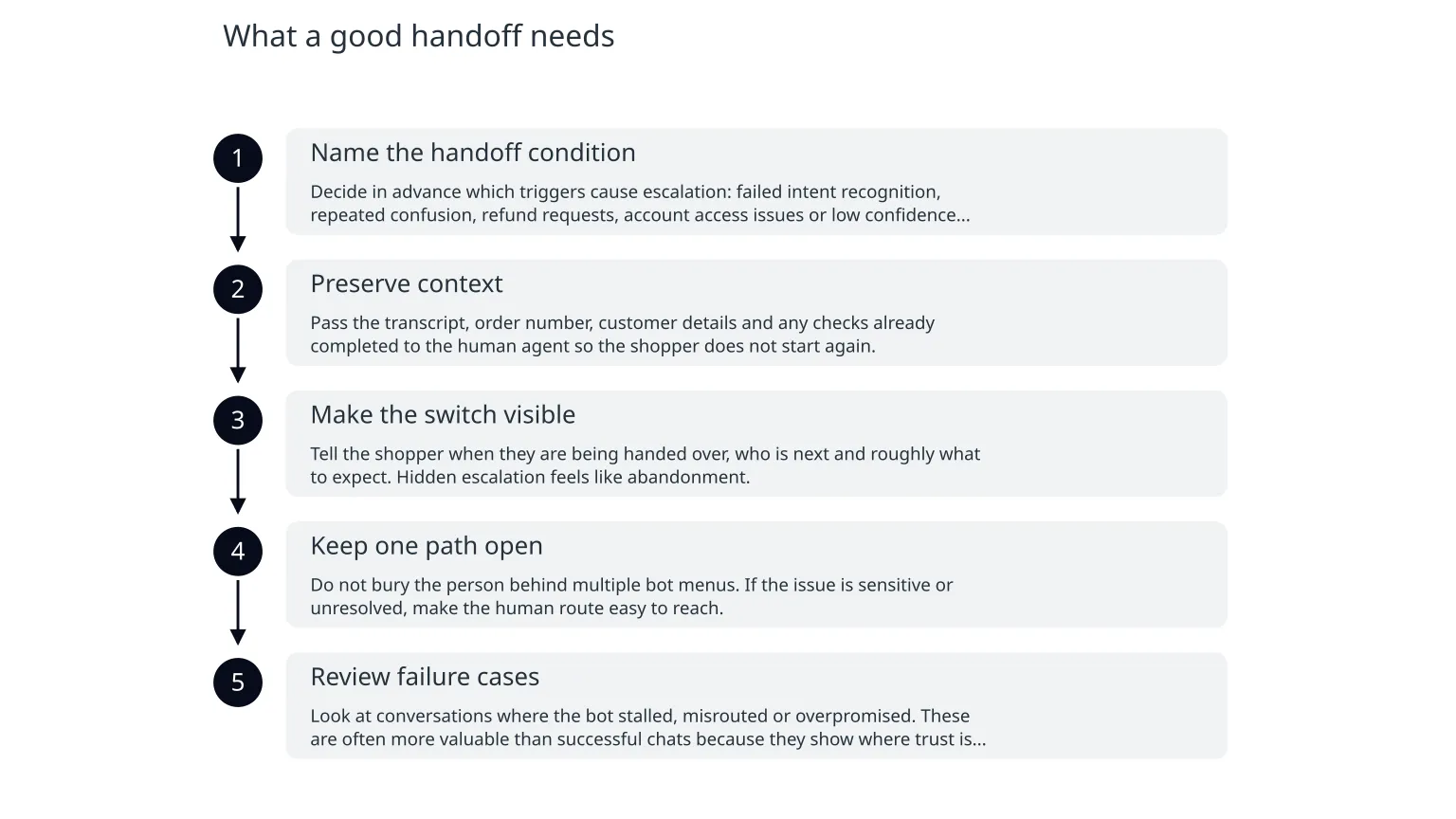
What a good handoff needs
- 1
Name the handoff condition
Decide in advance which triggers cause escalation: failed intent recognition, repeated confusion, refund requests, account access issues or low confidence in the answer.
- 2
Preserve context
Pass the transcript, order number, customer details and any checks already completed to the human agent so the shopper does not start again.
- 3
Make the switch visible
Tell the shopper when they are being handed over, who is next and roughly what to expect. Hidden escalation feels like abandonment.
- 4
Keep one path open
Do not bury the person behind multiple bot menus. If the issue is sensitive or unresolved, make the human route easy to reach.
- 5
Review failure cases
Look at conversations where the bot stalled, misrouted or overpromised. These are often more valuable than successful chats because they show where trust is being lost.
What to measure instead of just deflection
Weak signal
Ticket deflection alone. This can look good even when the customer gives up, retries later or abandons the purchase.
Stronger signal
Resolution rate, time to useful answer, escalation quality, repeat contact rate and whether the shopper completed the task.
If you only track how many conversations the bot handled, you will reward containment rather than service quality. A better scorecard asks whether the shopper got the right answer, at the right time, with the right amount of human help.
- Track whether the first answer was useful, not just fast.
- Check whether escalations kept the conversation history intact.
- Look for abandoned chats and repeat contacts after bot interactions.
- Compare support outcomes to conversion outcomes where possible.
Practical safeguards before you scale
0 of 7 complete
These safeguards are not just operational hygiene. They protect the buying experience. Support that is fast but unreliable can do more harm than slower, clearer service. The right balance depends on your product, but the principle is stable: let AI handle routine work, and let people take over before the conversation becomes costly to the customer.
A sensible way to start
Start with one narrow support journey, not the whole help centre. Order status, delivery questions or basic returns are often better starting points than complaint handling or complex pre-sales advice. Define the handoff point before launch, then test it with real edge cases.
After that, review a small sample of conversations each week. Ask three questions: did the AI help, did it know when to stop, and did the human take over with enough context? If any answer is no, improve the design before expanding the bot into more sensitive journeys.

About the author
Nixim Team, Product Engineering
Practical guidance from Nixim on building software, working with AI and running dependable cloud systems.