
Which accounts should you protect first, and is it worth introducing passkeys now?
A practical priority framework for phased stronger login protection: start with the accounts that would hurt most if stolen, then roll out passkeys where they fit and keep recovery simple for everyone else.

On this page
Why firstPasskeysPhaseRecoveryTrade-offsNext stepsIn short
- Prioritise admin, finance, email and support accounts first.
- Use passkeys where a service supports them, especially for privileged users.
- Keep fallback methods available, but do not make them the new normal.
- Recovery matters as much as the primary login method.
- A phased rollout is usually safer and easier than a big-bang switch.
If you try to “upgrade login” across a whole business in one go, you usually end up with two problems: people get locked out, or the lowest-risk users carry the heaviest sign-in burden. A better approach is to start with the accounts that would cause the most damage if taken over, then work down the list.
That is also the right way to think about passkeys. They are worth introducing now where your systems support them, especially for high-impact accounts, but they are not a blanket rollout decision. The real question is: which accounts should move first, what should stay as fallback, and how do you keep recovery sensible?
Start with the accounts that would hurt most
The UK NCSC’s guidance points in a clear direction: protect privileged access first, and choose the strongest sign-in method that fits the risk, usability and recovery needs of the organisation. For a small business, that usually means the accounts that can change money, reset other passwords, alter settings or see sensitive customer data.
Protect first
Admin accounts, finance tools, email, support systems, cloud consoles and anything that can reset or control other users.Protect next
Customer-facing staff accounts with access to personal data, order history, refunds or internal notes.Protect later
Low-risk accounts that do not expose money, admin control or sensitive data if compromised.Where passkeys fit
Passkeys are worth considering now because they can reduce the risk of phishing-style sign-in theft, especially on higher-risk accounts. The NCSC ranks FIDO2 credentials highest among recommended MFA types, and that includes passkey-based approaches where supported.
What passkeys do well
They reduce dependence on typed passwords and one-time codes that can be phished, reused or tricked out of a user.
What they do not solve
They do not remove the need for good recovery, device management, access reviews or sensible privilege limits.
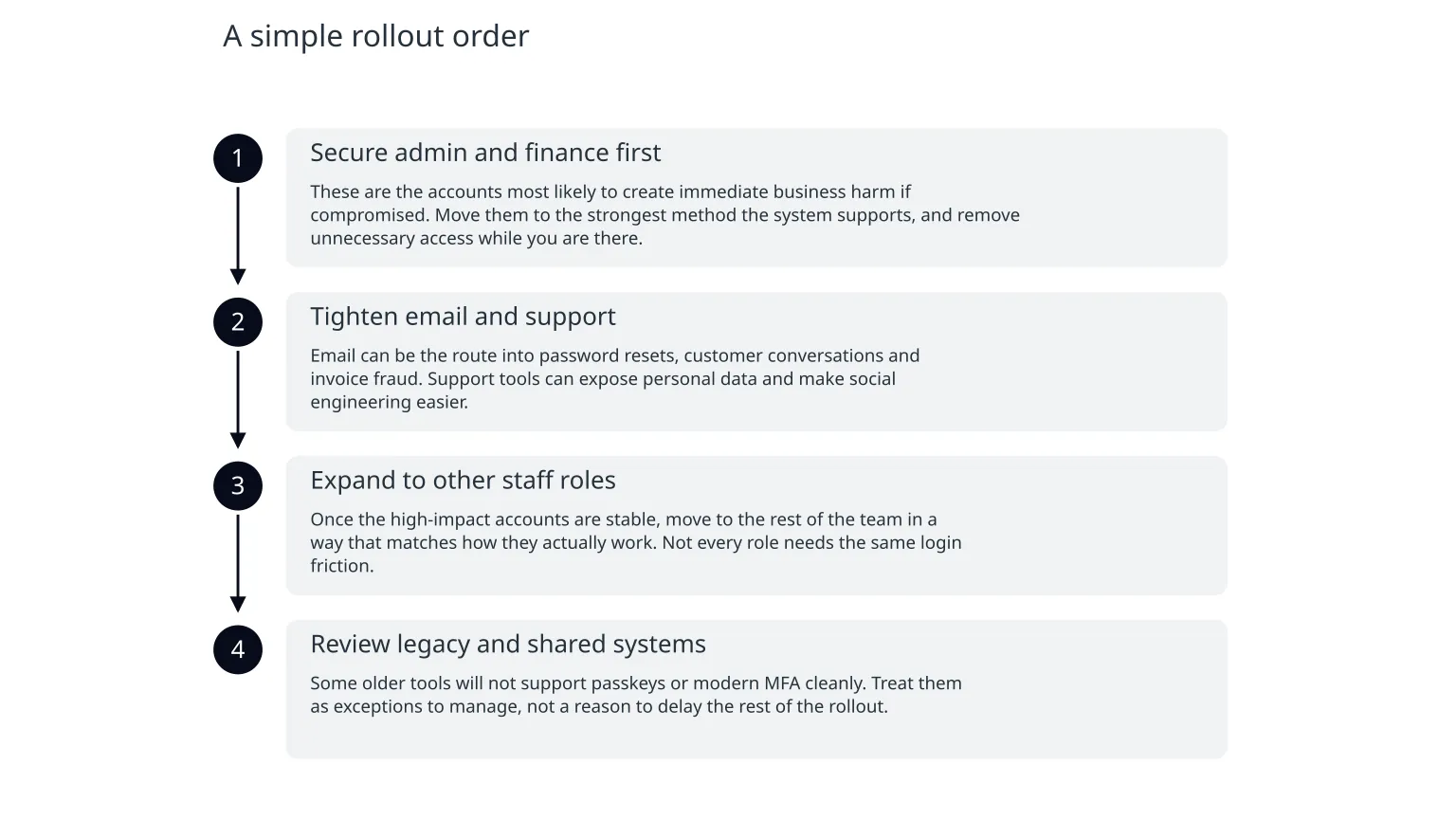
A simple rollout order
- 1
Secure admin and finance first
These are the accounts most likely to create immediate business harm if compromised. Move them to the strongest method the system supports, and remove unnecessary access while you are there.
- 2
Tighten email and support
Email can be the route into password resets, customer conversations and invoice fraud. Support tools can expose personal data and make social engineering easier.
- 3
Expand to other staff roles
Once the high-impact accounts are stable, move to the rest of the team in a way that matches how they actually work. Not every role needs the same login friction.
- 4
Review legacy and shared systems
Some older tools will not support passkeys or modern MFA cleanly. Treat them as exceptions to manage, not a reason to delay the rest of the rollout.
Keep fallback and recovery sensible
Strong authentication only works if people can recover access without creating a bigger security hole. This is where many rollouts go wrong: the team adds a stronger primary login, but leaves weak recovery paths untouched.
- Make sure recovery methods are documented and limited to the smallest sensible group.
- Review who can approve account recovery and what evidence they need.
- Avoid letting one weak channel become the default workaround for everyone.
- Test what happens when a user loses a phone, changes device or cannot access a shared workplace system.
- Treat SMS or message-based methods as fallback when no stronger option is available, not as the target state.
What to watch out for
Benefit
Better resistance to phishing and account takeover on the accounts that matter most.
Trade-off
More setup effort, more support questions during rollout, and possible friction on older devices or legacy apps.
The mistake to avoid is overcomplicating low-risk users just because a stronger method exists. A phased approach lets you concentrate effort where the business impact is highest, while leaving lower-risk accounts on a simpler path until there is a clear reason to change.
0 of 6 complete
A practical way to begin this week
You do not need a full identity programme to start. Pick the top five accounts that would hurt most if stolen, review how they are protected today, and move them to the strongest supported method one by one. If passkeys are available, use them where they fit best. If they are not, choose the strongest practical MFA option and make recovery explicit.
- Start with high-impact accounts, not every account.
- Use passkeys where the service and your user setup support them.
- Keep recovery tight, documented and tested.
- Avoid turning fallback into the default route.
- Revisit access and privileges at the same time as authentication.

About the author
Nixim Team, Product Engineering
Practical guidance from Nixim on building software, working with AI and running dependable cloud systems.