
Which software changes help you win more customers before you hire more people?
A practical guide for founders, owners and operations leaders on using CRM, order flow, automation and better handoffs to improve customer acquisition and service capacity before adding headcount.

On this page
Why this mattersWhere to startHow it worksTrade-offsPractical stepsWhen to ask for helpBottom lineIn short
- Look for the bottleneck first: lead capture, follow-up, quoting, ordering or service handoff.
- A basic CRM helps only if it is kept up to date and tied to a clear process.
- Automation should remove repetitive admin, not hide exceptions that still need a person.
- Better handoffs often improve conversion more than another campaign does.
- Start with one workflow, one owner and one measurable outcome.
If growth is starting to stretch your team, the instinct is often to hire. Sometimes that is the right move. But for many small businesses, the first bottleneck is not people. It is the way leads, orders, follow-ups and handoffs move through the business.
That is why a useful question is not “what marketing should we do next?” It is “which software changes will help us win and keep more customers before we add more headcount?” The answer is usually less about a big platform change and more about a few practical improvements: a simple CRM, clearer order flow, automation for repetitive tasks, and fewer dropped handoffs.
UK evidence supports this systems-first view. The SME Digital Adoption Taskforce says smaller businesses can improve productivity through basic digital tools such as cloud software, CRM and ERP-style systems, but also notes that many firms face barriers such as cost, lack of expertise and switching risk. ONS data also suggests adoption matters, but execution matters too: firms with stronger management practices were much more likely to adopt advanced technologies, and the main barriers included unclear use cases and lack of skills.
Growth often breaks at the handoff, not the advert
Start with the friction, not the slogan
Many teams look for growth help in the wrong place. They focus on more leads, more ads or a better pitch, when the real problem is that promising leads are not being captured, followed up, quoted or onboarded consistently. If the process is messy, adding more enquiries can just add more mess.
The practical goal is to remove friction between interest and action. That might mean a better CRM, a clearer order process, automatic reminders, or a shared view of who owns the next step. These are not flashy changes, but they often create the capacity to handle more customers without immediately increasing payroll.
Four software changes that usually pay back first
- A CRM that records every lead, source, next step and owner.
- A cleaner order or quote flow with fewer manual re-typing steps.
- Simple automation for reminders, routing and status updates.
- Shared handoffs so sales, operations and support all see the same customer context.
1) CRM discipline
A customer relationship management system does not create demand by itself. What it can do is stop leads being lost in inboxes, notebooks or half-finished spreadsheets. For a small team, the most valuable CRM change is usually not more features. It is consistent use.
Illustrative example: a founder can set up one pipeline with a few clear stages such as enquiry, qualified, quoted, won and live. If every lead has an owner and a next action, follow-up becomes visible instead of accidental. That can improve conversion simply by reducing delay and confusion.
2) Order and quote flow
If your business sells services or products through a manual quoting or ordering process, customers often feel the friction before you do. Re-entering data, waiting for approvals and chasing missing details all slow down purchase.
A better system may mean structured intake forms, pre-filled templates, approval steps and automatic confirmation emails. The point is not to remove judgment. It is to remove avoidable repetition so people spend time on exceptions, not retyping.
3) Workflow automation
Automation helps most when the same task repeats often and the rules are clear. Typical examples include routing enquiries to the right person, sending follow-up reminders, moving orders between stages or alerting the team when something stalls.
ONS research shows AI adoption is still relatively shallow in many UK firms, and barriers include identifying a useful use case and having the skills to implement it. That is a useful reminder that the safest first automation is usually simple and visible, not ambitious and opaque.
4) Better handoffs
A surprising amount of lost revenue comes from poor internal handoffs. A lead is qualified but the implementation team does not know the promise that was made. Or support hears about a recurring issue after the customer has already lost patience.
Shared notes, agreed fields and a single source of truth can make a real difference here. Even without changing your marketing, you may win more customers simply by responding faster, quoting more consistently and onboarding with fewer mistakes.
A sensible sequence for small teams
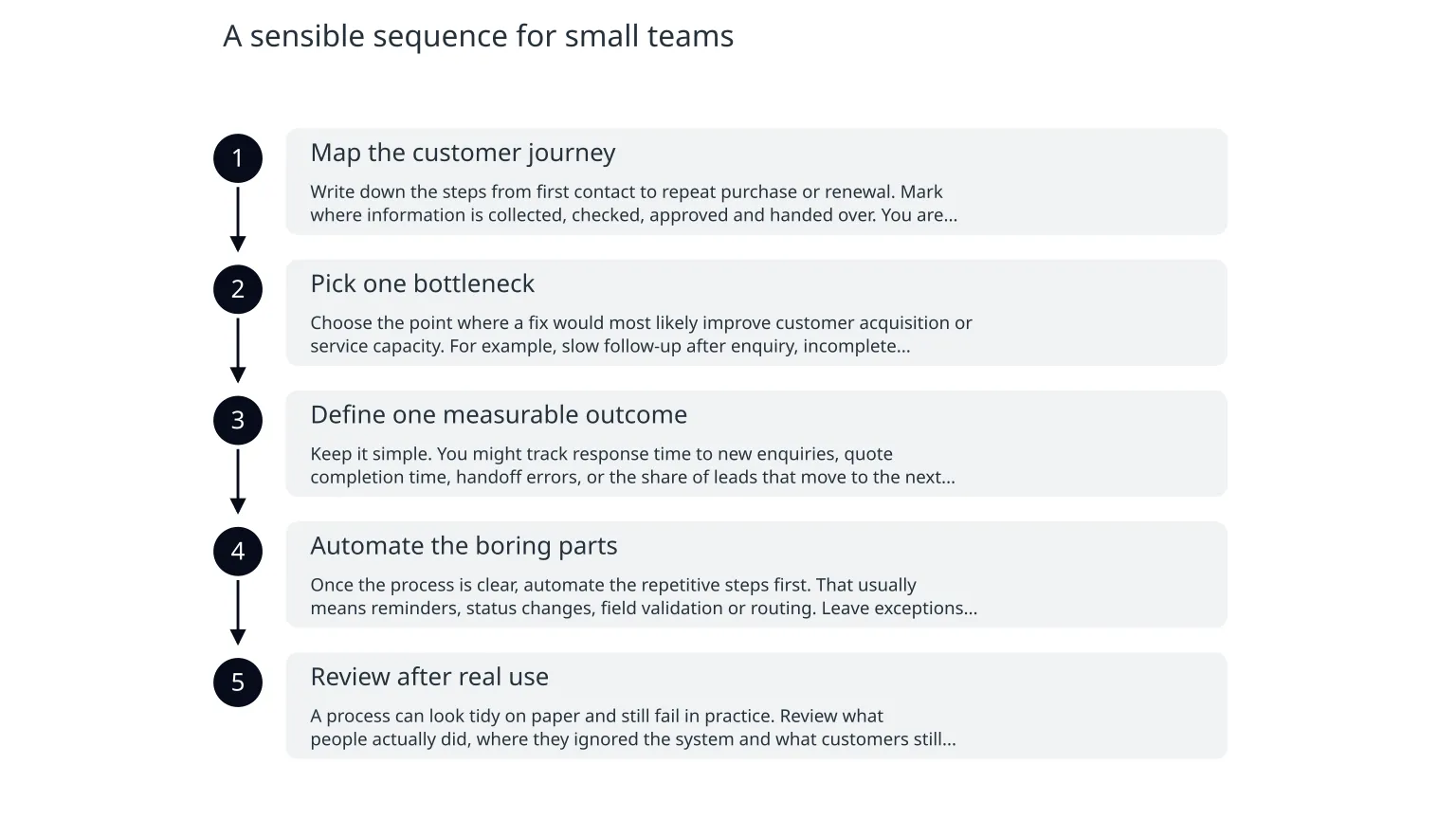
- 1
Map the customer journey
Write down the steps from first contact to repeat purchase or renewal. Mark where information is collected, checked, approved and handed over. You are looking for delays, duplicate work and places where people depend on memory.
- 2
Pick one bottleneck
Choose the point where a fix would most likely improve customer acquisition or service capacity. For example, slow follow-up after enquiry, incomplete quoting, or missed handoffs between sales and delivery.
- 3
Define one measurable outcome
Keep it simple. You might track response time to new enquiries, quote completion time, handoff errors, or the share of leads that move to the next stage. The goal is not a perfect dashboard. It is a visible before-and-after change.
- 4
Automate the boring parts
Once the process is clear, automate the repetitive steps first. That usually means reminders, status changes, field validation or routing. Leave exceptions and judgment points with a person.
- 5
Review after real use
A process can look tidy on paper and still fail in practice. Review what people actually did, where they ignored the system and what customers still had to repeat. Then simplify again.
What these changes can and cannot do
What software can do
Reduce manual work, make ownership visible, speed up follow-up, reduce dropped handoffs and help the team handle more volume with the same people.
What software cannot do
Fix a weak offer, invent demand, or make a confused process work without management attention. Tools support the business model; they do not replace it.
Why management quality matters
The ONS found that firms with stronger management practice scores were much more likely to adopt advanced technologies. That does not mean only “well managed” companies can benefit. It does mean that implementation discipline matters. If the process is messy, the software will reflect the mess. If the process is clear, the software can make it repeatable.
A simple way to choose your next change
| Problem you feel | Software change to test | What to watch for |
|---|---|---|
| Leads go cold | Basic CRM with reminders | Response time, missed follow-ups, stage conversion |
| Quotes take too long | Structured quoting and approval flow | Turnaround time, rework, customer questions |
| Orders are retyped by hand | Connected order intake and status updates | Data errors, handoff delays, duplicate entry |
| Team members keep asking for context | Shared customer record and notes | Fewer internal chases, fewer dropped tasks |
| Support is overwhelmed by repeat questions | Simple automation and knowledge routing | Fewer repetitive tickets, faster first response |
0 of 6 complete
When specialist support is useful
Not every fix is a DIY job
Some teams can set up a simple CRM and a few automations themselves. Others need help because the work crosses sales, operations, data and customer service. Specialist support is useful when the process is unclear, integrations are needed, or the team needs a safe way to change live systems without disrupting customers.
That is where product and software delivery help can be valuable: scoping the workflow, deciding what to automate, building the integration, and making sure the team can own it after launch. For Nixim, this is the kind of practical problem that sits naturally across growth-focused product work, data, cloud and automation.
Keep the scope small
The best first project is often a focused one: a cleaner lead pipeline, a better order flow, or a handoff process that removes obvious waste. That keeps the change understandable, testable and easier to measure. It also lowers the risk of buying a large system you do not yet need.
Growth before headcount is usually a systems question
- Look for the bottleneck in how customers move through the business.
- Use CRM, order flow and automation to reduce friction, not to cover up a weak process.
- Better handoffs often improve growth more reliably than more marketing spend.
- Start with one workflow, one owner and one measure.
- Only scale the system once it works in real use.
Closing thought
If you want more customers before you hire more people, start by making sure the customers you already attract can move cleanly through your business. In many cases, that means a few careful software changes rather than a big reinvention. The aim is not more technology for its own sake. It is a clearer, faster path from interest to revenue.

About the author
Nixim Team, Product Engineering
Practical guidance from Nixim on building software, working with AI and running dependable cloud systems.